At the end of September 2023 (25 September – 3 October) I was once again visiting my sister on the Costa Blanca – this time without Patrycja. Together with my sister and my aunt, we got away for a three-day road trip to central Spain, around Madrid: to El Escorial, the Valley of Cuelgamuros, Segovia and Toledo. Each of these places deserves a day of its own – we saw the most important sights.
Table of contents
- El Escorial – monastery and palace of the Spanish kings
- The Valley of Cuelgamuros
- Segovia – the Roman aqueduct and the Alcázar
- Toledo – the old town and the cathedral
- Practical information
El Escorial – monastery and palace of the Spanish kings
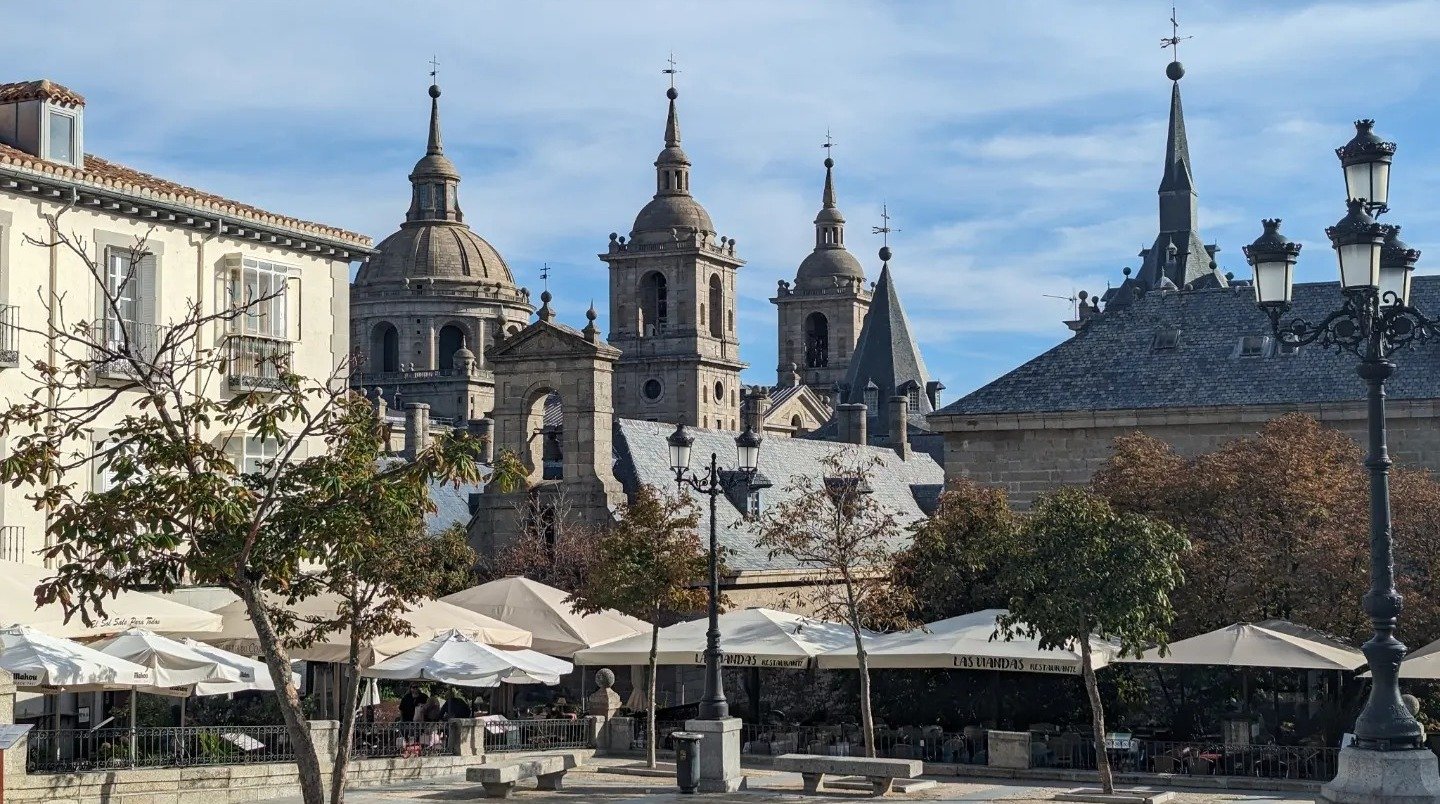
We started in the town of San Lorenzo de El Escorial, at the Real Monasterio de San Lorenzo de El Escorial – a huge monastery and palace complex built in the 16th century by order of King Philip II and listed by UNESCO. It includes a monastery, a palace, a basilica and the pantheon of the Spanish kings, and the interiors are decorated with, among other things, Baroque ceiling frescoes (there is a photo of the complex at the top of the post).
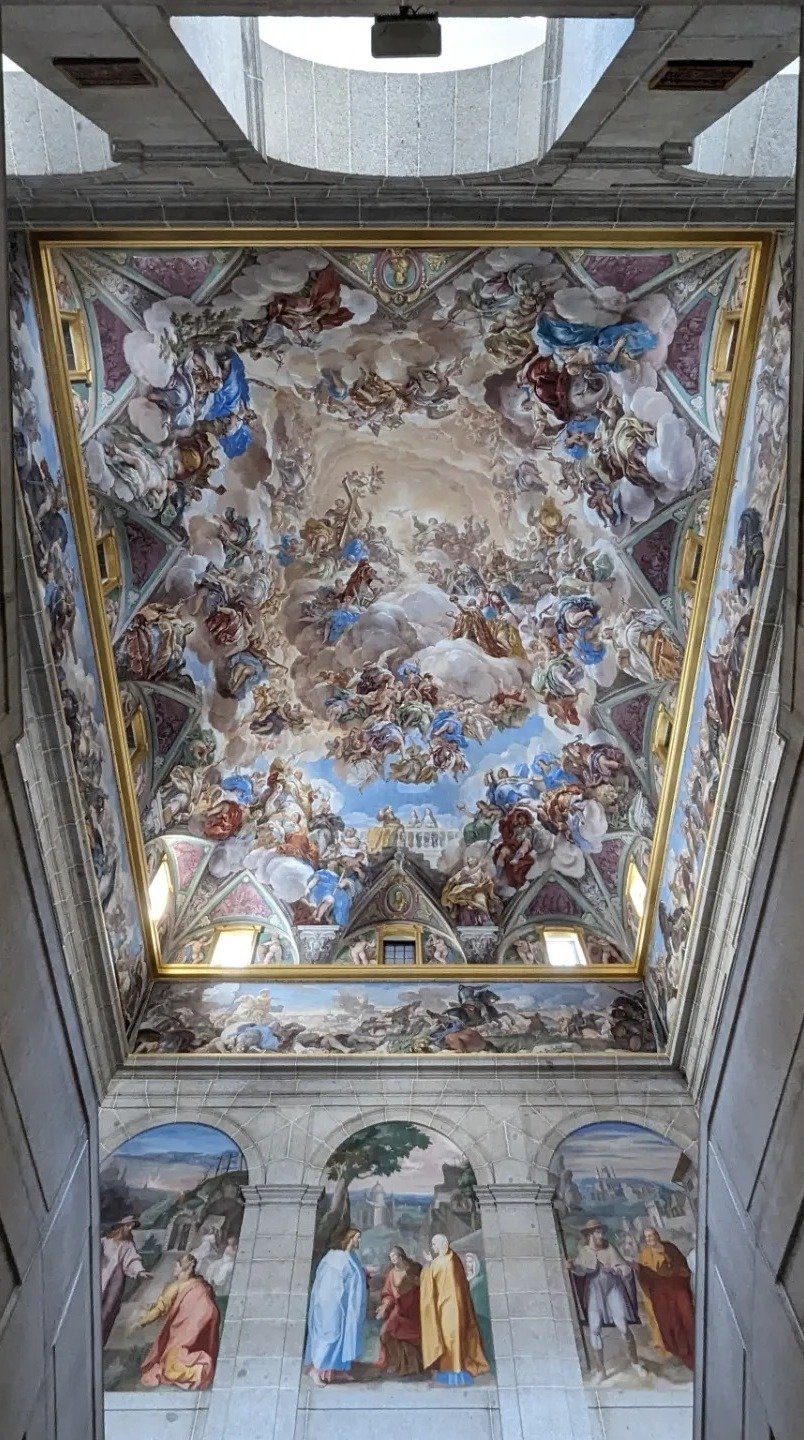
The visit leads through courtyards, cloisters with paintings and palace rooms, and from the windows and terraces you can see geometric gardens with mountains behind.


The complex was built in 1563–1584. Philip II founded it partly to commemorate the victory at Saint-Quentin on 10 August 1557, the feast of St Lawrence – the monastery’s patron. The palace part includes the Hall of Battles (Sala de las Batallas), a gallery about 60 m long whose walls are covered with battle frescoes, among them the Battle of La Higueruela of 1431. From the terraces by the monastery you can see the skyscrapers of Madrid in the distance, about 40 km away.


Beneath the high altar of the basilica lies the Pantheon of Kings with 26 marble sarcophagi, holding the kings and queens of Spain from the Habsburg and Bourbon dynasties – with a few exceptions. After the visit we walked around the town of San Lorenzo de El Escorial, which grew up around the monastery, and had a meal there.


The Valley of Cuelgamuros
A few kilometres further on, in the Sierra de Guadarrama mountains, lies the Valley of Cuelgamuros (called Valle de los Caídos until 2022) – a mausoleum commemorating the victims of the Spanish Civil War, with a basilica carved into the rock and a cross on the hill over 150 metres tall.
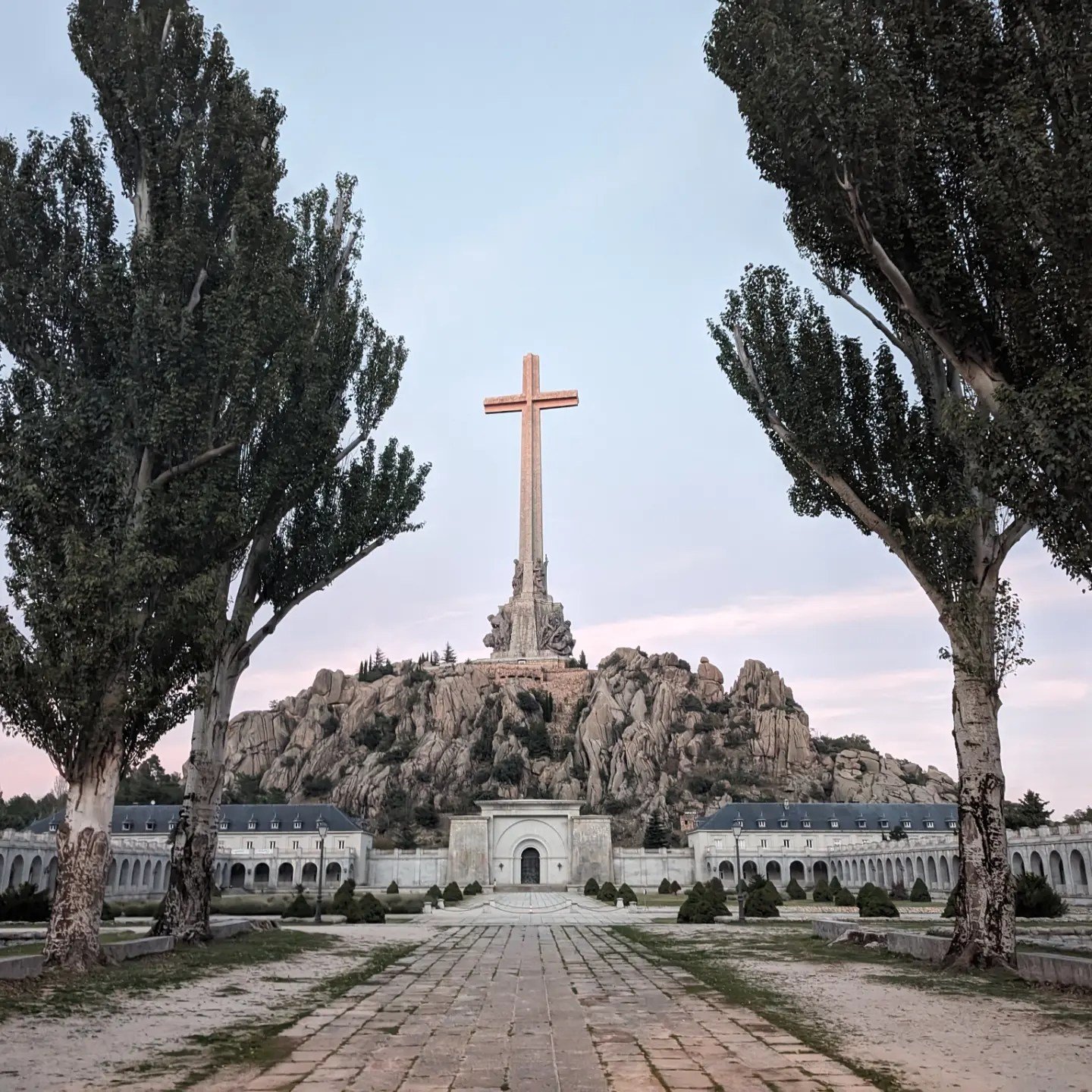
It was built in 1940–1958, and the rock-cut basilica is over 260 m long. General Franco was buried here until 2019, when his remains were moved to a cemetery near Madrid. Behind the hill stands a Benedictine abbey with a guesthouse, and the valley looks out over the peaks of the Sierra de Guadarrama.


We spent the night in the guesthouse (hospedería) by the abbey – a former monastery building with long arcaded galleries. In the morning we went back to the esplanade in front of the basilica. Above its entrance stands a Pietà by Juan de Ávalos, and the crypts hold more than 33,000 dead from both sides of the Civil War. The funicular that used to take visitors up to the foot of the cross is currently closed (as of 2026).


Segovia – the Roman aqueduct and the Alcázar
Our next stop was Segovia. Its symbol is the Roman aqueduct, which has been crossing the city above the rooftops for almost two thousand years.
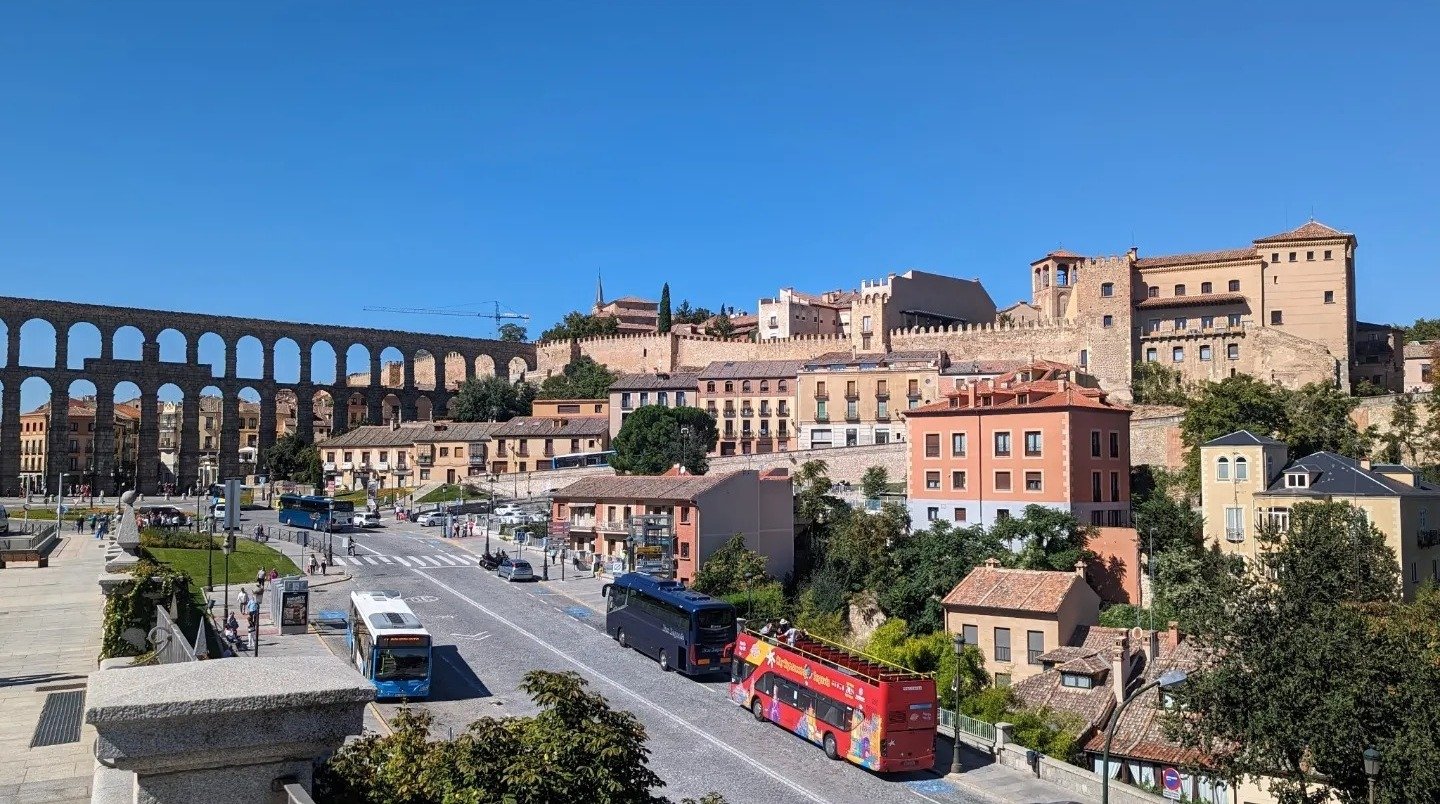
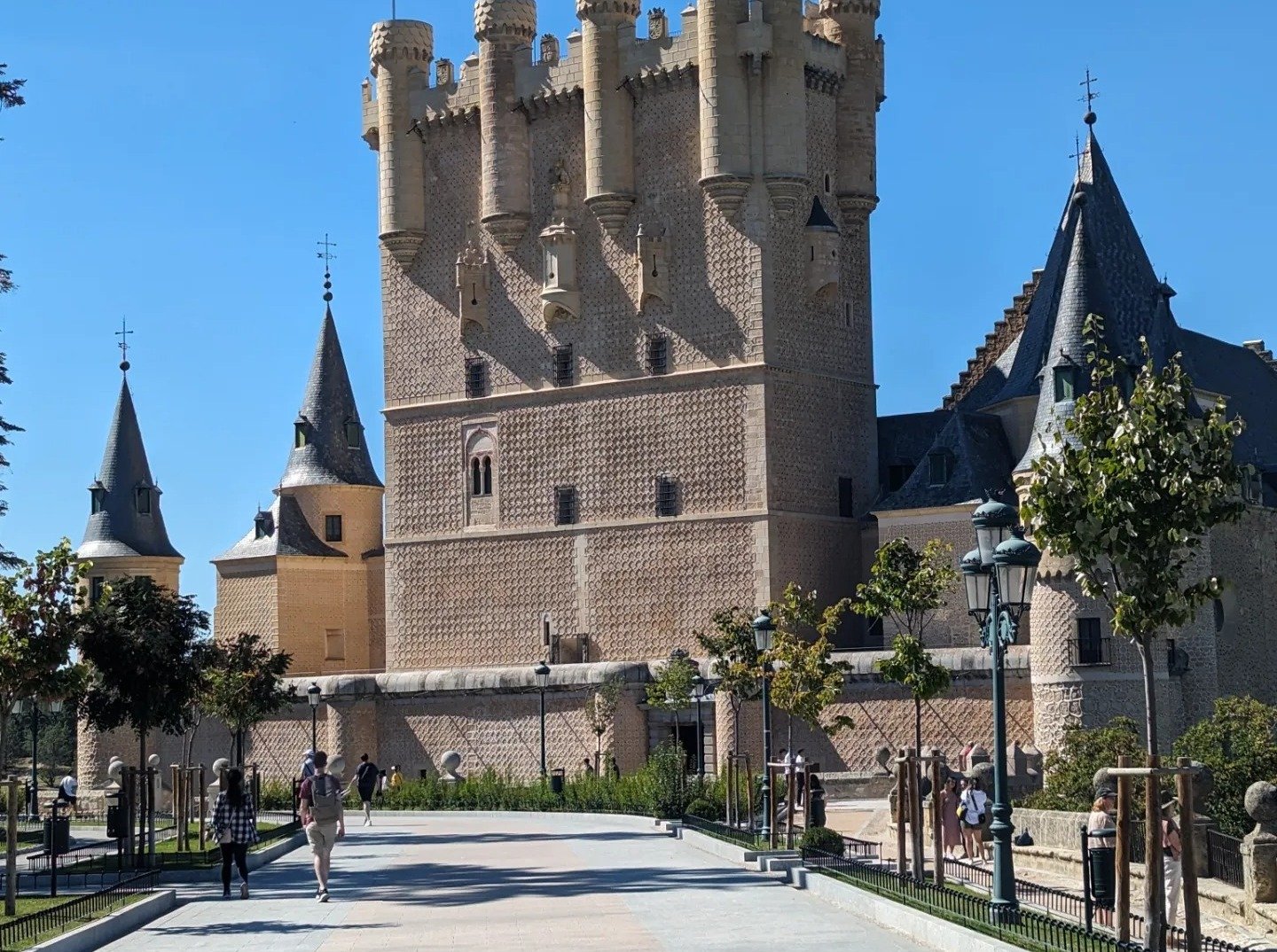
At the other end of the old town, on a rock above two rivers, stands the Alcázar – a beautiful castle with a tall tower and pointed slate roofs.
The aqueduct has more than 160 arches, is almost 29 m high at its tallest and was built without mortar. The late Gothic cathedral also towers over the old town and can be seen from afar.


The aqueduct was built at the beginning of the 2nd century AD, under the emperor Trajan or Hadrian. It carried water from a mountain spring about 17 km away and remained in use until 1973. Together with the old town it has been a UNESCO World Heritage Site since 1985. From the viewpoint by the walls, where the aqueduct reaches the old town, you see it from above, with the Sierra de Guadarrama range beyond the rooftops.


Construction of the cathedral began in 1525, making it one of the latest Gothic cathedrals in Europe; its tower is almost 90 m high. It stands on the Plaza Mayor, the town’s main square with café terraces. A few streets away is the Romanesque church of San Esteban from the 12th century, with an arcaded gallery and a tower about 50 m high – once the tallest Romanesque bell tower on the Iberian Peninsula.


In 1862 a fire destroyed the Alcázar’s roofs and interiors, which were later rebuilt. It was from here that Isabella the Catholic set out on 13 December 1474 to be proclaimed Queen of Castile, and 152 steps lead up the Tower of John II. Segovia is also famous for cochinillo, roast suckling pig – the windows of many restaurants advertise it. In the mid-20th century Cándido López, owner of the Mesón de Cándido inn, became famous for carving the piglets with the edge of a plate.


Toledo – the old town and the cathedral
Finally we went to Toledo, with its impressive old town on a hill above the Tagus river, also a UNESCO World Heritage Site. What impressed us most was the Gothic Cathedral of Saint Mary, especially in the evening, in the light of the setting sun.
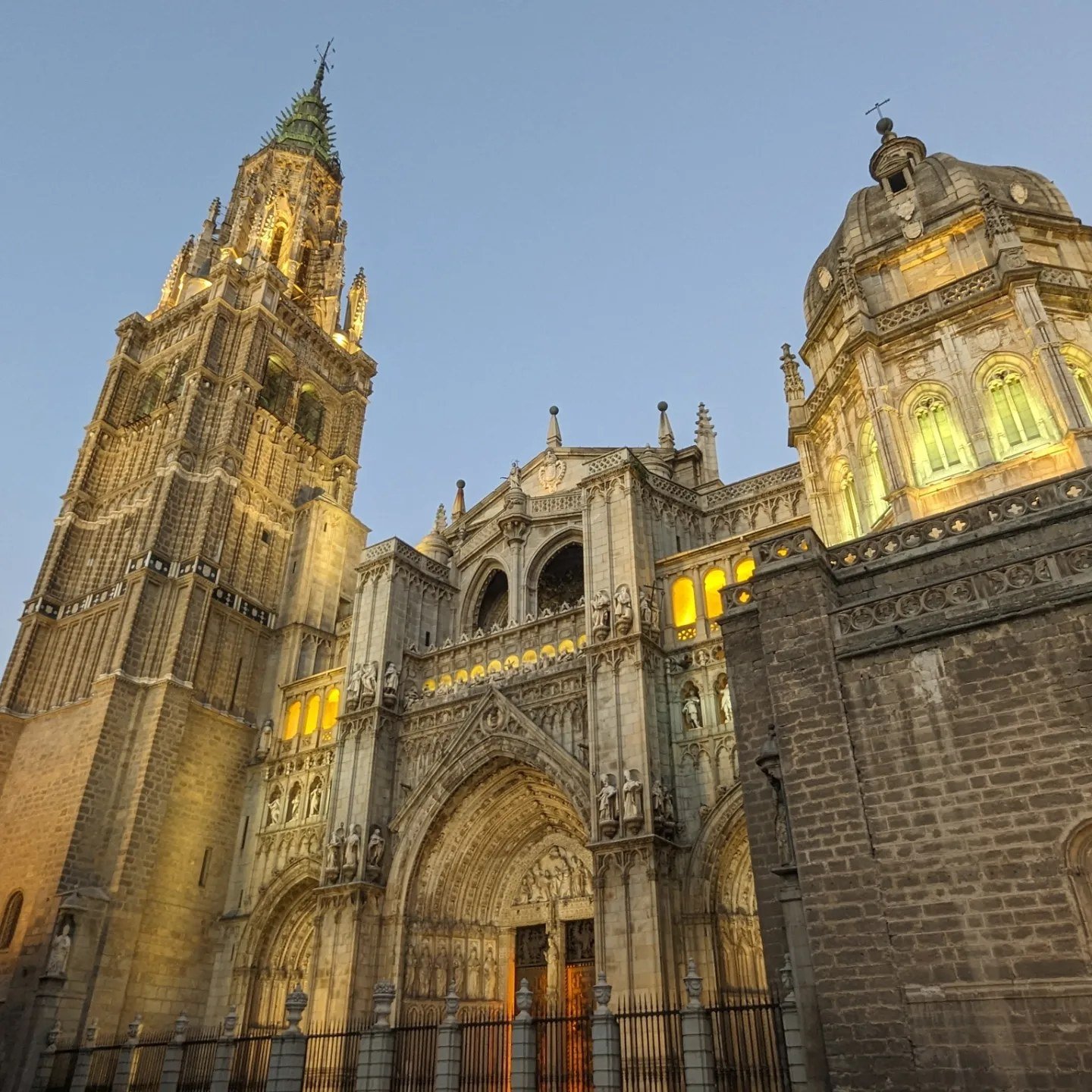
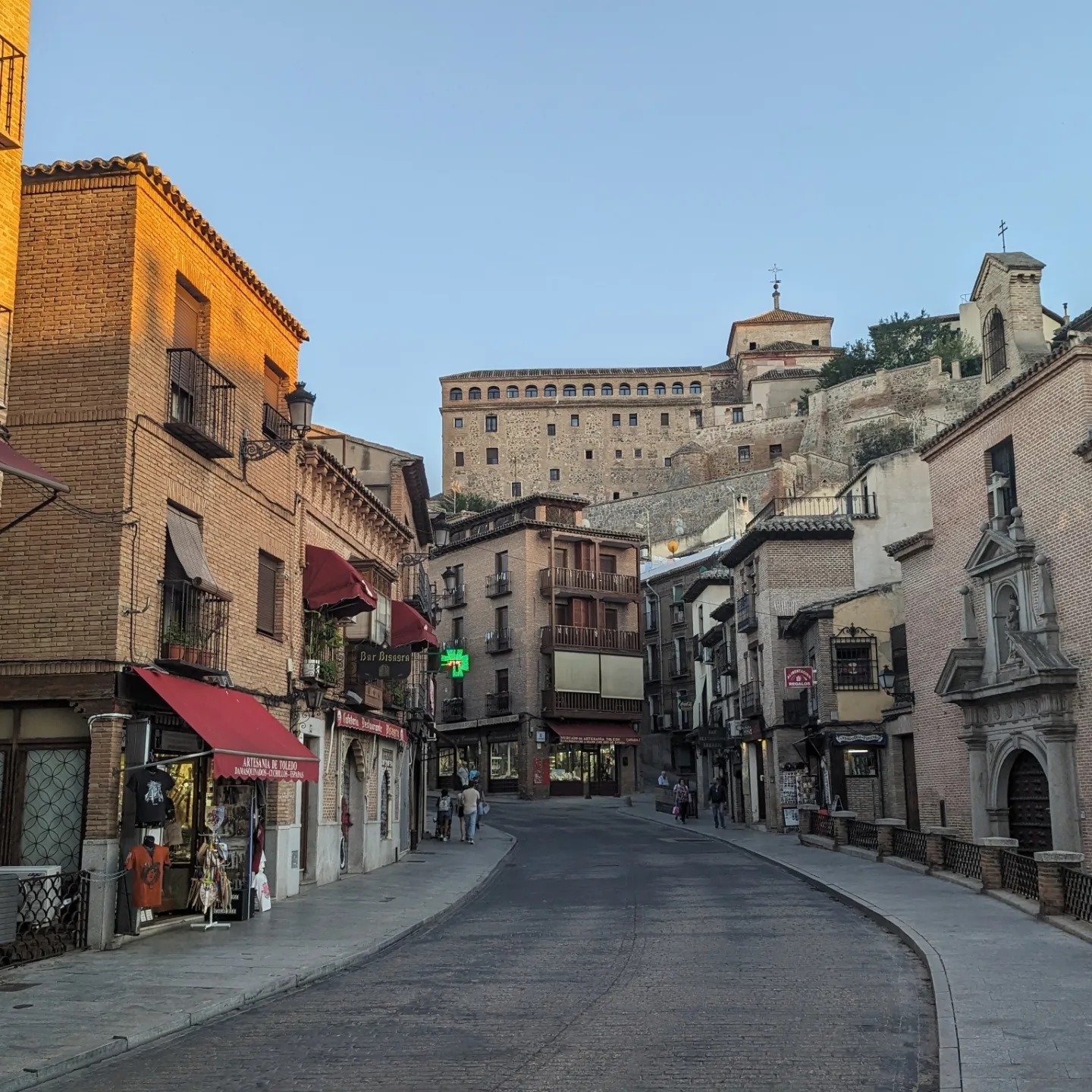
The Puerta de Bisagra gate leads into the old town. The highest point of Toledo is taken up by the Alcázar, now home to the Army Museum.


Right by the Bisagra gate stands the church of Santiago del Arrabal from the second half of the 13th century – one of the finest examples of Toledo’s Mudéjar style, in which Christian churches were built of brick and decorated with patterns from Islamic art. Higher up, on the way to the centre, stands the Puerta del Sol gate from the late 14th century, with a horseshoe arch. It takes its name from a relief of the sun.


The next morning we went to the Paseo del Miradero viewpoint, which looks out over the rooftops of Toledo and the districts beyond the walls. There stands a bronze statue of the cyclist Federico Martín Bahamontes, known as the “Eagle of Toledo”, who in 1959 became the first Spaniard to win the Tour de France. It was unveiled in 2018 in the presence of the cyclist himself; he died in August 2023, a few weeks before our visit.


The Tagus flows round the old town on three sides through a deep gorge. From the Alcázar we walked to the edge of the escarpment, which looks down on the river and the Puente de Alcántara bridge. The bridge dates back to Roman times and was rebuilt in the 10th century; its name comes from the Arabic al-qantara, which simply means “the bridge”.


On the way back south-east we stopped in La Mancha, by the white windmills on a hill that bring Don Quixote to mind.


I spent the rest of my stay on the Costa Blanca – the day before my flight, my sister and I also took a boat to Tabarca island.
Practical information
- Without a car – Toledo and Segovia can be reached from Madrid by fast Avant trains in about half an hour (Segovia-Guiomar station lies outside the centre, so you continue by city bus), and El Escorial by Cercanías commuter trains.
- El Escorial – a ticket costs €14 (reduced €7). The monastery is open Tuesday to Sunday, from October to March 10:00–18:00 and from April to September until 19:00; it is closed on Mondays. EU citizens get in free on Wednesdays and Sundays from 15:00 – these tickets are issued only at the ticket office.
- Valley of Cuelgamuros – a ticket costs €9 (reduced €4); closed on Mondays. You can stay overnight in the abbey’s guesthouse.
- Segovia – the aqueduct is free to see. The Alcázar is open daily (November to March 10:00–18:00, April to October 10:00–19:30); tickets for the Tower of John II often sell out, so it is better to buy them in advance.
- Toledo – entry to the cathedral costs €12 (reduced €8); it can be visited Monday to Saturday 10:00–18:30 and on Sundays 14:00–18:30. In 2026 the cathedral marks 800 years since construction began.
- How much time – three days are enough for the main sights; it is convenient to stay overnight in Toledo and in the Valley of Cuelgamuros or San Lorenzo de El Escorial.
- Prices and opening hours – as of 2026.