

Los Angeles – the City of Angels, or simply L.A., is a city known from countless film productions. No wonder many people associate it mainly with the home of the stars and the “Entertainment Capital of the World”. Does this city really exude wealth, luxury and endless parties? Below you’ll find a description of the attractions we got to see during our fairly short stay!
We flew to Los Angeles after finishing Work & Travel in Grand Teton National Park. Here we were joined, as arranged earlier, by three Poles – Wojtek, Kasia and Karolina – and here we rented the car in which we then set off on a tour of the national parks of the western USA.
Many people mistakenly confuse the city of Los Angeles with the Los Angeles metropolitan area. The city’s population (~4 million people) is only about 20% of the population of the whole metropolitan area. So Long Beach, Santa Ana, Santa Monica and Beverly Hills, among others, are separate cities. As in most American cities, the streets of Los Angeles were laid out on a grid – they cross at right angles.
One of the most exclusive places in the United States, home to many famous and wealthy personalities. It is criss-crossed by streets lined with palm trees, with villas next to them. The best-known street is undoubtedly Rodeo Drive, with lots of luxury boutiques. It’s pretty, but in reality it’s nothing special. Nearby there is also the Witch’s House (Spadena House).
We parked the car at Brighton Public Parking (9510 Brighton Way) – it’s free for up to two hours.
Santa Monica Boulevard runs through Beverly Hills – the whole street is part of the historic Route 66, as the brown “Historic Route 66” signs remind you. The famous road was laid out in 1926; it linked Chicago with California and was about 2,448 miles (almost 3,940 km) long. Santa Monica Boulevard ends at Ocean Avenue, right by the ocean in Santa Monica.
A walk along Hollywood Boulevard with over 2800 stars awarded in categories such as motion pictures, television, recording, live performance and radio. A star on the Walk can be given to a person, a band, a cartoon character and even an animal. As for Polish touches, you can spot the stars of Pola Negri, Ignacy Paderewski and Max Factor. It’s worth stepping off the crowded street for a moment into the Chinese Theatre (Grauman’s Chinese Theatre) or the Hollywood & Highland shopping centre, which has a replica of the Babylonian Ishtar Gate.
The first permanent star was set into the pavement on 28 March 1960 – it went to the director Stanley Kramer. The Walk stretches for 15 blocks of Hollywood Boulevard and 3 blocks of Vine Street. The emblem in the middle of each star shows its category: a camera for film, a TV set for television, a record for recording, a microphone for radio and masks for theatre and live performance. So the star of Pola Negri, a Polish silent film actress, has a camera, and Elvis Presley’s has a record.
In the theatre’s forecourt there are almost 200 handprints, footprints and autographs of Hollywood personalities.
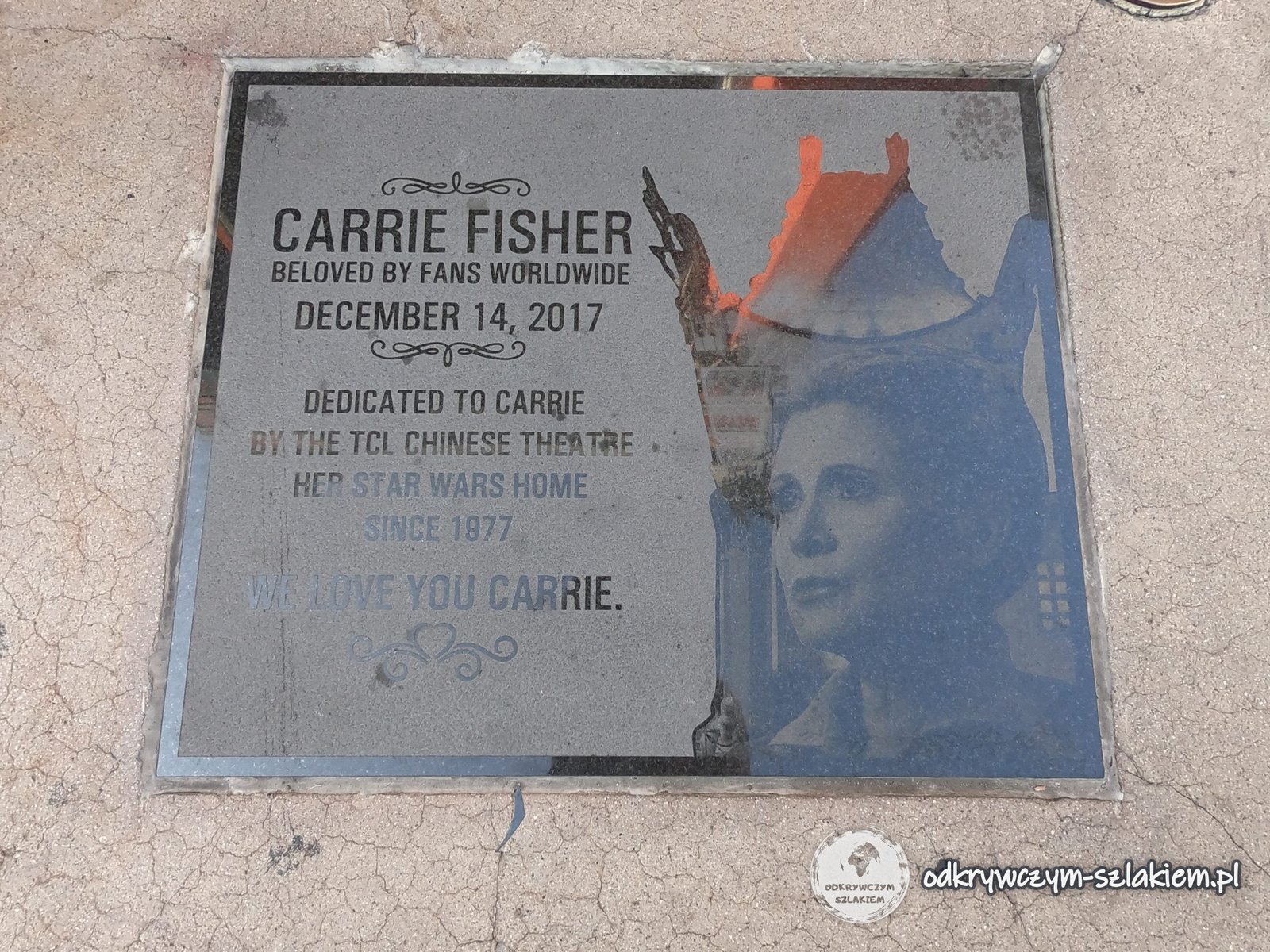
The theatre opened on 18 May 1927 with the premiere of Cecil B. DeMille’s “The King of Kings”. The first prints were left on 30 April 1927 by Mary Pickford and Douglas Fairbanks, although according to the official version the tradition was started by Norma Talmadge, who accidentally stepped into wet concrete. The Academy Awards ceremonies were held here in 1944–1946, and in 1977 it hosted the world premiere of “Star Wars”. That is why there is a memorial plaque to Carrie Fisher, the film’s Princess Leia, unveiled in December 2017. Since 2013 the cinema has been called the TCL Chinese Theatre.
Griffith Observatory is first and foremost an astronomical observatory on the southern slope of Mount Lee. Many people (us included) also treat it as a viewpoint with a beautiful view over downtown Los Angeles.
In season, even late in the day (or maybe especially then), it’s hard to find a parking space. In the end we managed to find one 1.5 km away (on Western Canyon Rd). Parking is paid (at a machine).
The land for Griffith Park – more than 3,000 acres, about 1,220 ha – was given to the city in 1896 by Griffith J. Griffith, who also left money in his will for a public observatory. It opened on 14 May 1935. Admission is free – you only pay for parking and planetarium shows. The observatory is open Tuesday to Friday from 12:00 to 22:00 and at weekends from 10:00 to 22:00; it is closed on Mondays (as of 2026). The parking pay stations only take cards, and instead of hunting for a space you can take the DASH Observatory/Los Feliz bus from the Vermont/Sunset Metro station.
A swing with a view of the city – an incredibly charming spot! When we were there, there were only two other tourists. So the place isn’t very crowded, which means there’s no problem taking photos (although we waited for them to finish their photo shoot first). It’s best to park on Angels Point Rd (near the junction with Park Row Dr) – there should be enough space. From there it’s a few minutes on foot and you’re there.
NOTE: I’ve read that in the meantime the swing has disappeared and reappeared. If you don’t want to be disappointed, check for information beforehand.
You can see the “Hollywood” sign relatively close up. Getting there can be tricky, though. In our opinion the best view is from Mulholland Hwy (from the Deronda Dr side) / the Last House Trail, specifically near “The Last House on Mulholland”. Going any higher is illegal, as red signs tell you. We found that out ourselves: we took the wrong path towards the sign itself and were warned twice – a man with a megaphone told us from afar that we weren’t allowed to walk there and that if we didn’t come down he’d send the police after us. We had seen the signs, but we thought they applied to the other path, since other people were walking along the one we were on.
You can also reach the sign from the other side (Mt Lee Dr), but you’d need to check which trails are currently open (the situation changes).
As for parking, you have to look for it in the winding streets nearby. In the end we managed to park at 6200 Rockcliff Dr. From there we had about 500 m to the Last House Trail. In the past, residents have sometimes put up illegal “no entry” signs on the streets to limit tourist traffic. You should ignore them.
Beaches are a must on any Los Angeles sightseeing list. The city famous for its long, practically endless sandy coastline is Malibu – we specifically chose El Matador Beach.
The car park is on a rise (about 40 m up). You pay at a machine. Remember also that it’s open until sunset. Because we dawdled a bit, the parking attendant had to wait for us before closing it.
Venice is famous for its artificial canals (hence the name Venice), its beach and Ocean Front Walk – a long pedestrian promenade. On the beach there is also a recreation centre with tennis courts, a basketball court, a playground and a skatepark. Not far away is the very famous Santa Monica Pier, where Route 66 ends, and where you can eat and enjoy the amusement park.
We spent the next two days mainly at amusement parks. The first of them – Knott’s Berry Farm – is in Buena Park. It offers about 40 rides, including roller coasters, family rides and water rides. We tried most of the attractions and only left when the park was closing. Here I had to overcome my fear of heights several times – most of the roller coasters here are tall and steep.
The park began as a roadside berry stand that Walter Knott opened in 1923. In 1932 Rudolf Boysen gave him the last plants of his cross-bred berry – that is how the boysenberry came to the Knotts. From 1934 his wife Cordelia served fried chicken dinners in a small tea room, which drew crowds, and in 1940 Walter started building a Wild West town – Ghost Town. Today the park has 43 attractions, including 10 roller coasters, and since 2024 it has belonged to Six Flags.
A large car park (paid, unfortunately) is right next to the amusement park. A one-day ticket bought online costs from $65 (as of 2026). You’ll find current prices at Knott’s Berry Farm here.
The second one is Universal Studios Hollywood in San Fernando, which of course also works as a film studio. The attractions are linked to various films and series that change over the years – e.g. Minions, The Simpsons, Jurassic Park, The Mummy, Transformers, Kung Fu Panda, Waterworld – but what we wanted most was the village from the world of Harry Potter :).
Of course I have to recommend the “Harry Potter and the Forbidden Journey” ride, which includes a walk through Hogwarts and ends with an amazing ride on an enchanted bench. This attraction was named the best in the world in the “Best Dark Ride” category, so I think that speaks for itself. It was such an incredible experience that it was the only attraction we decided to ride twice. I’ll only reveal that it felt as if we were really flying on a broomstick :). Of course it was also great to see the Ollivanders wand show and walk around Hogsmeade.
Types of attractions: roller coaster, dark ride, interactive experience, live show, indoor roller coaster, 3D dark ride, motion simulator, film, stunt show, swing ride and tram tour. One full day is completely enough.
If you’re looking for parking, I recommend leaving the car somewhere along Lankershim Blvd. We parked for almost the whole day in a spot where parking was free, but only for up to 3 hours – not very sensible, but nothing happened. Either way, you should then have 5–10 minutes to the place where a free bus regularly leaves for Universal Studios – the Universal Studios Shuttle bus, at 10-333 Universal Hollywood Dr.
You’ll find the list of current attractions and ticket prices here.
There’s no denying that the city lives for film. On Angels Point Rd we came across a film crew, and at the Rosenheim Mansion (the house from the first season of American Horror Story) some filming was going on as well :).
Within Los Angeles itself we drove 255 km. From here we headed further east – 261 km to the Jumbo Rocks campground in Joshua Tree National Park, and then to the Grand Canyon. I describe the whole route in the 30-day USA itinerary.
Stay with me on the road – follow me wherever you like best.
Clicking loads the profiles from Facebook, Instagram and YouTube (they may set cookies).