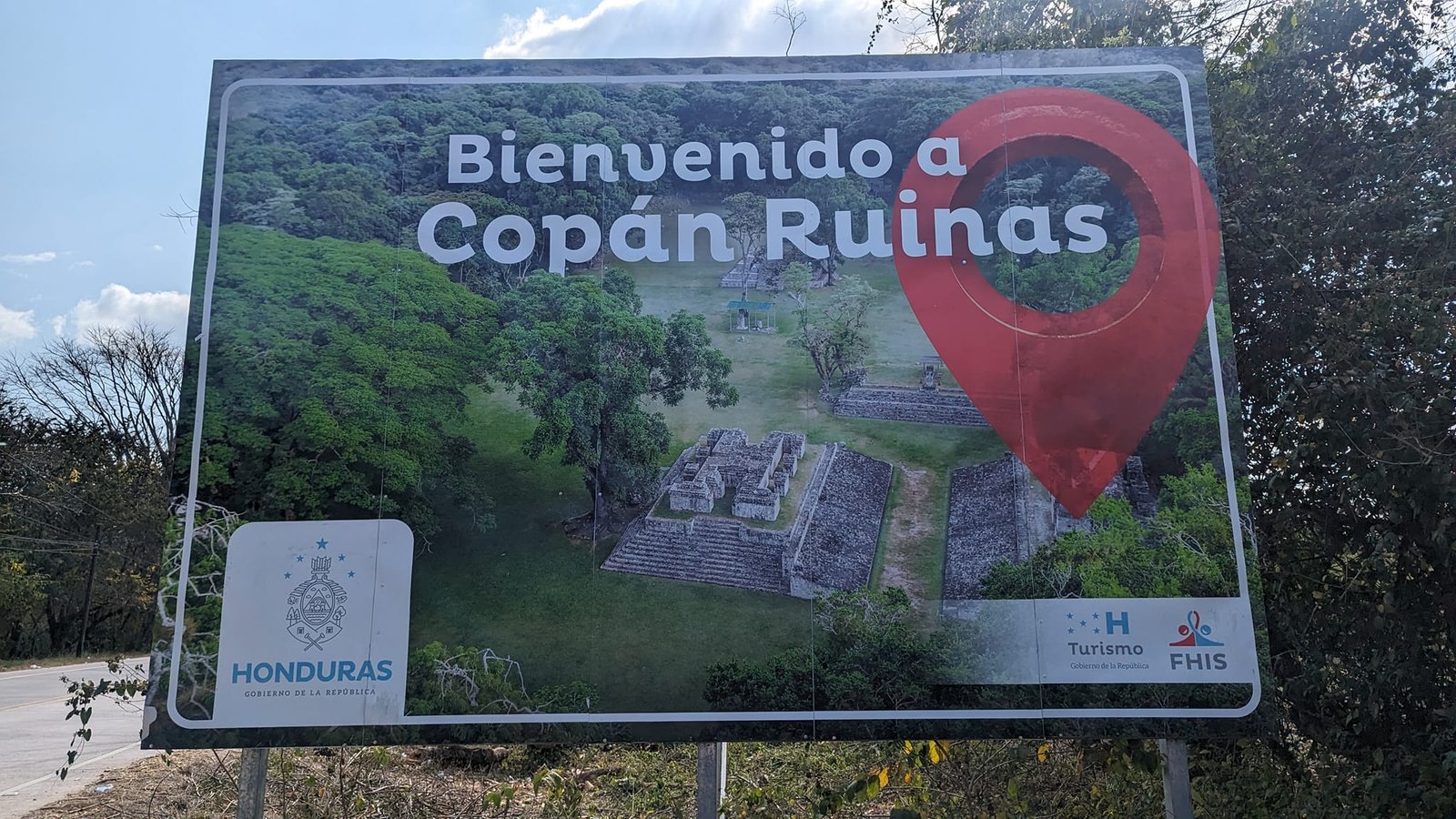
Honduras, just like El Salvador, was not on our list at first – mainly for safety reasons. We were only going to pass through it by bus on our way to Nicaragua. But as so often happens on the road, the plan changed, and it was all down to snorkelling in Belize: we enjoyed swimming along the reef so much that we decided to do a diving course, and Honduras has some of the cheapest in the world. Since we were coming anyway, we wanted to see more than just the island. Our choice fell on Copán Ruinas – a small town in the west of the country, near the border with Guatemala, right next to the famous Maya ruins.
We spent 20 days in Honduras in total (from 29 February to 19 March 2024) and stuck to places considered safe: Copán Ruinas, La Ceiba and the island of Utila. This post is about the ruins, the town and getting there, while the diving course, La Ceiba and the ferry to Utila have a separate post: Utila – diving course, the ferry from La Ceiba and island life. A short film from our whole stay in Honduras – Copán Ruinas and Utila:
 1:00
Table of contents
- The Copán ruins – the easternmost Maya city
- The Hieroglyphic Stairway, stelae and sculptures
- The ball court and scarlet macaws
- Tickets and visiting
- The town of Copán Ruinas
- Getting there from El Salvador via El Poy
- Safety in Honduras and the onward journey
- Practical information
The Copán ruins – the easternmost Maya city
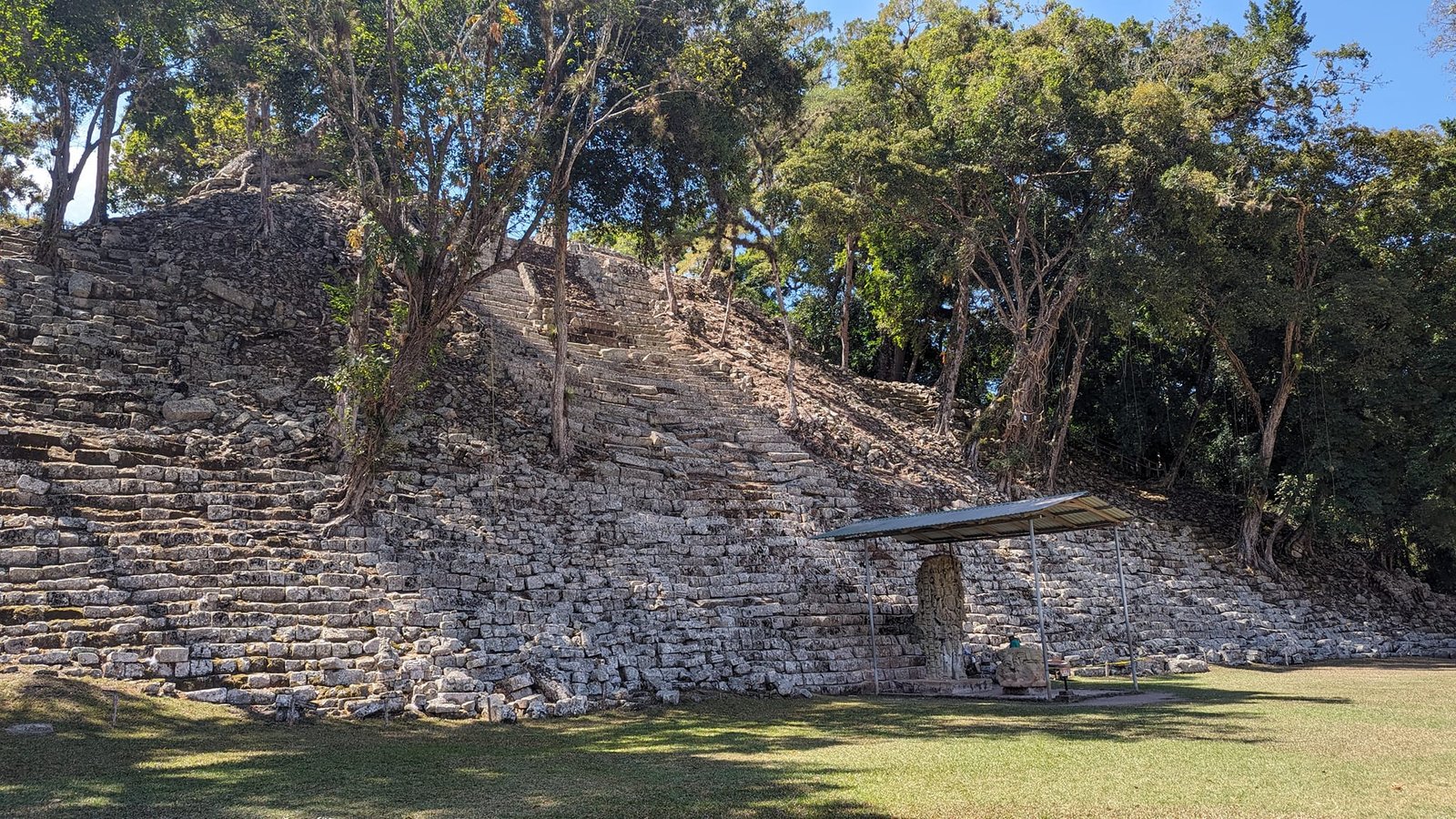
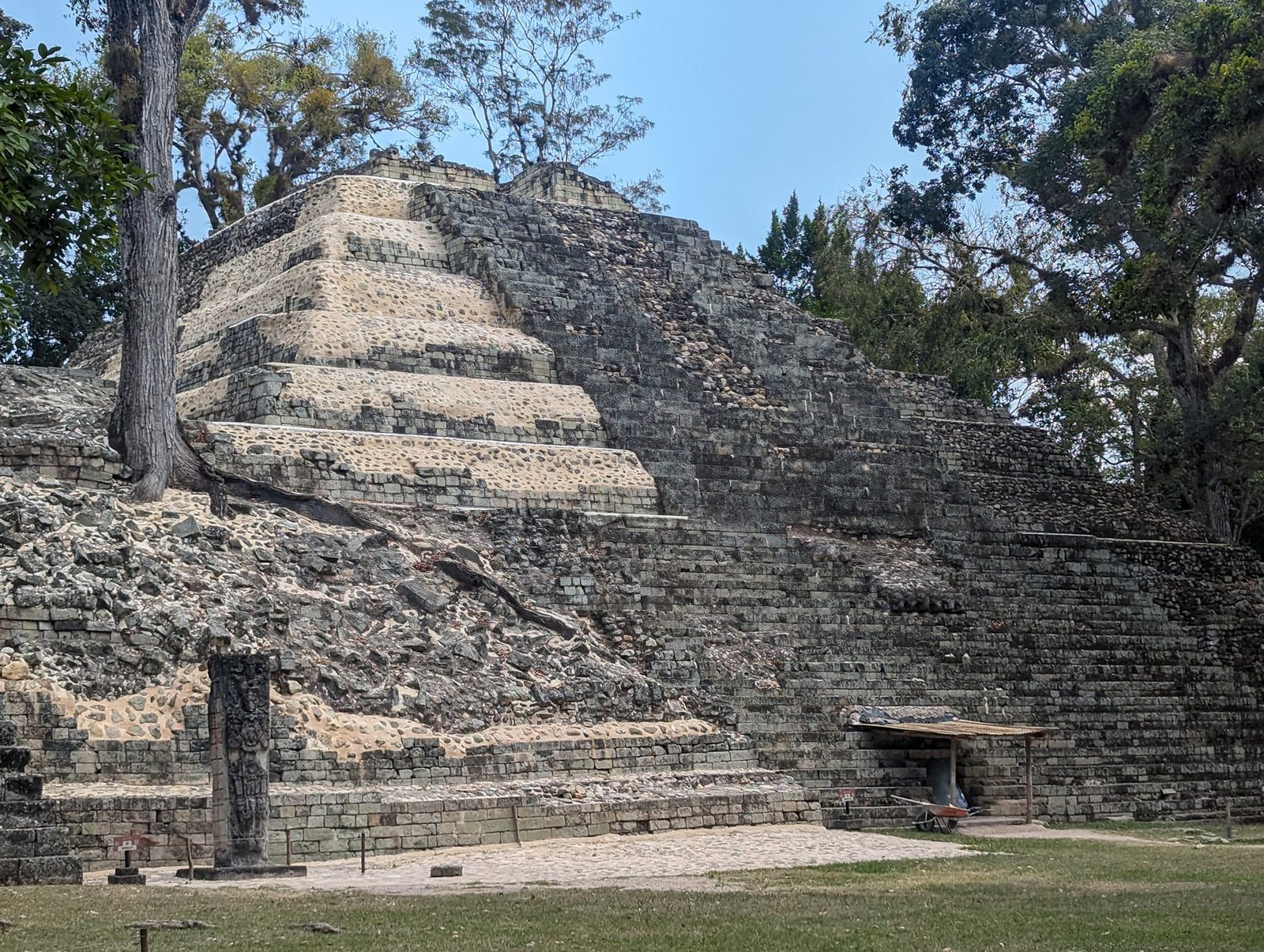
We visited the ruins on 1 March 2024. According to current knowledge, Copán is the easternmost Maya city. It was discovered in the 16th century, and in the 19th century the American explorer John Lloyd Stephens bought it – for 50 USD – so that he could continue studying it. The city was at its height in the 5th–8th centuries, when it was the capital of a powerful Maya kingdom. It is estimated that as many as about 200,000 people may have lived here at the time.
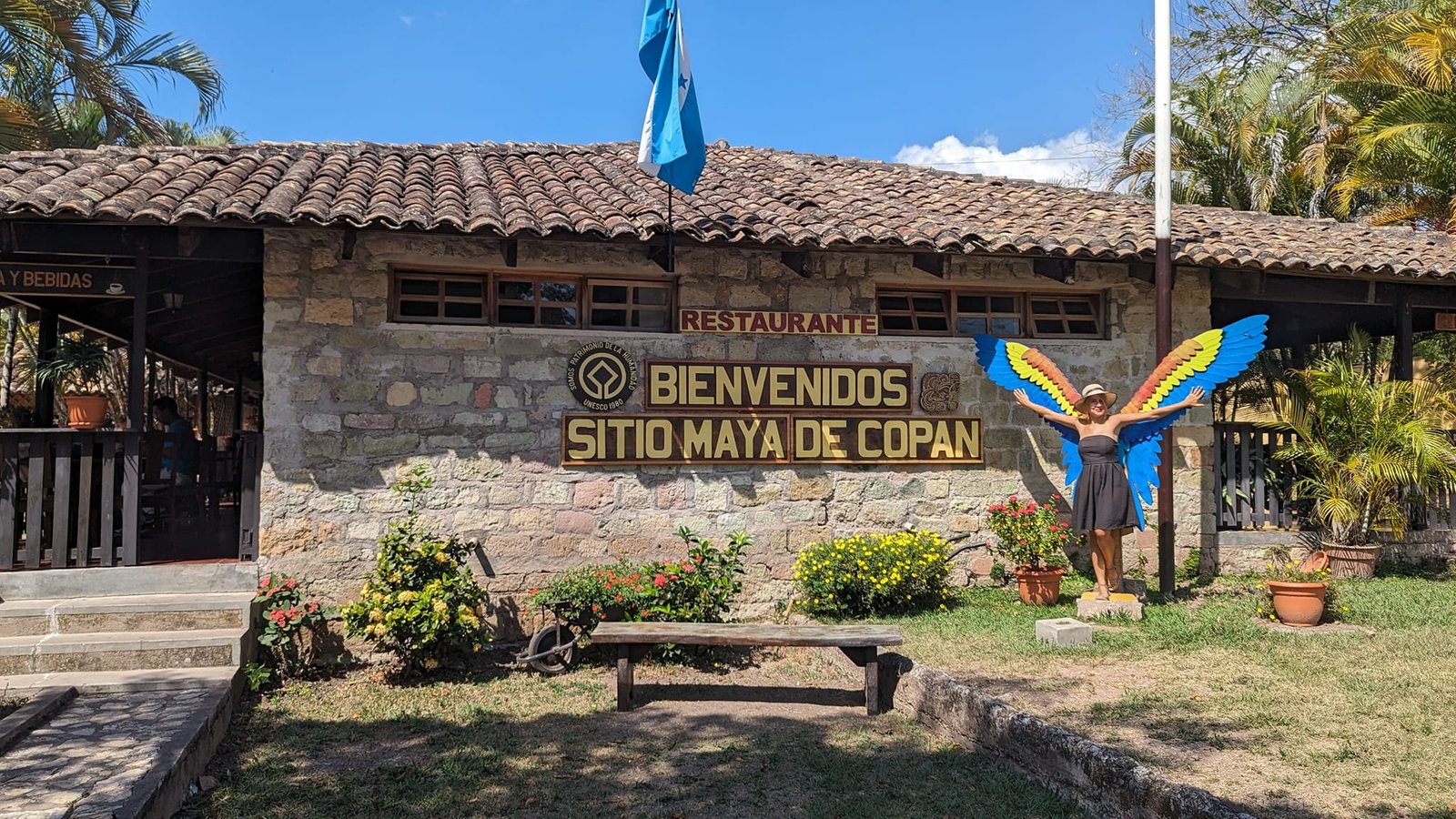
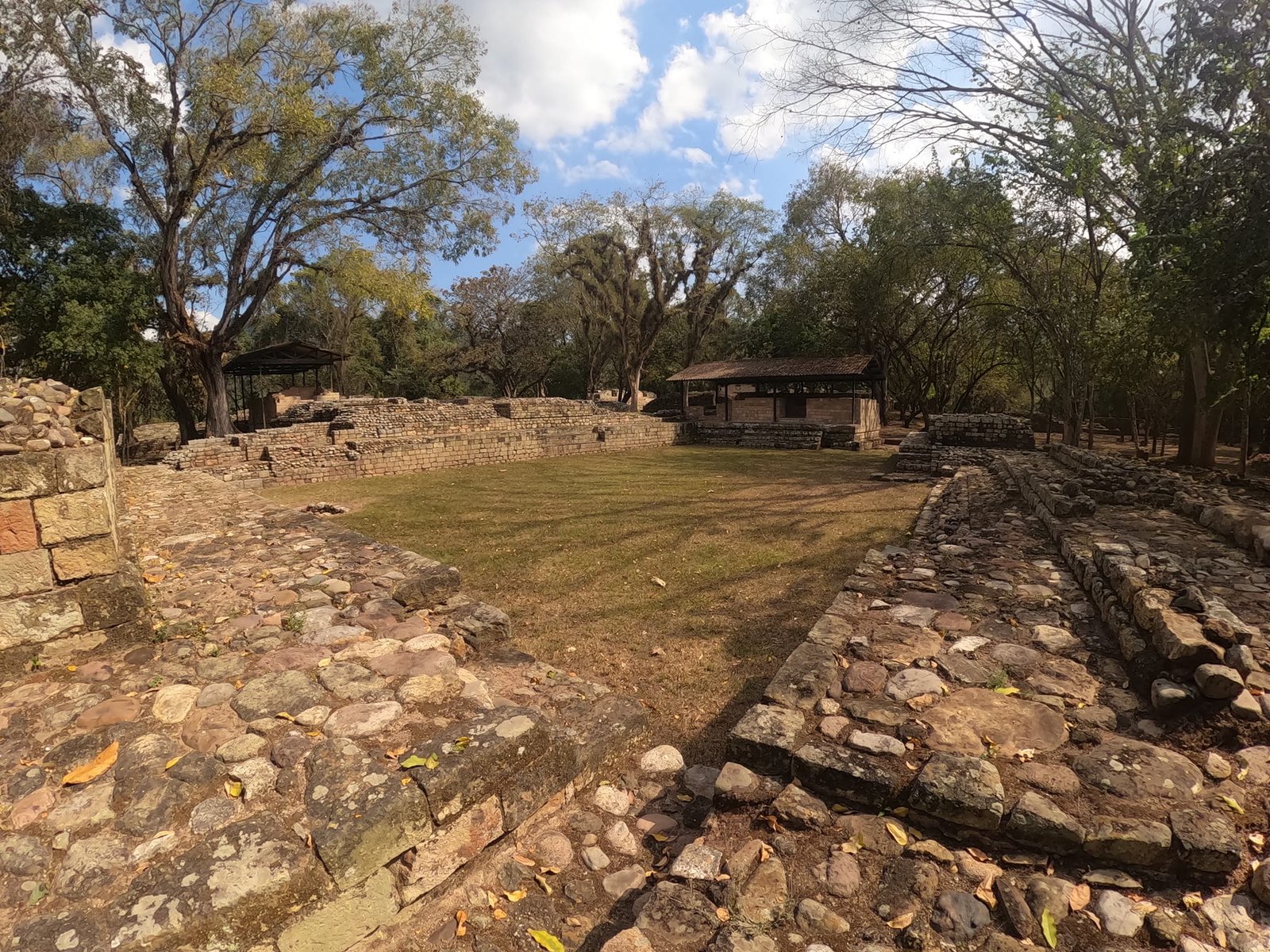
Today it is a vast, green archaeological park: huge trees grow between the pyramids, plazas and former buildings, and the valley is surrounded by forested mountains. We had already seen Maya cities before, including Tikal in Guatemala, but Copán stands out for something other than the height of its pyramids – its sculptures and inscriptions.
The Hieroglyphic Stairway, stelae and sculptures
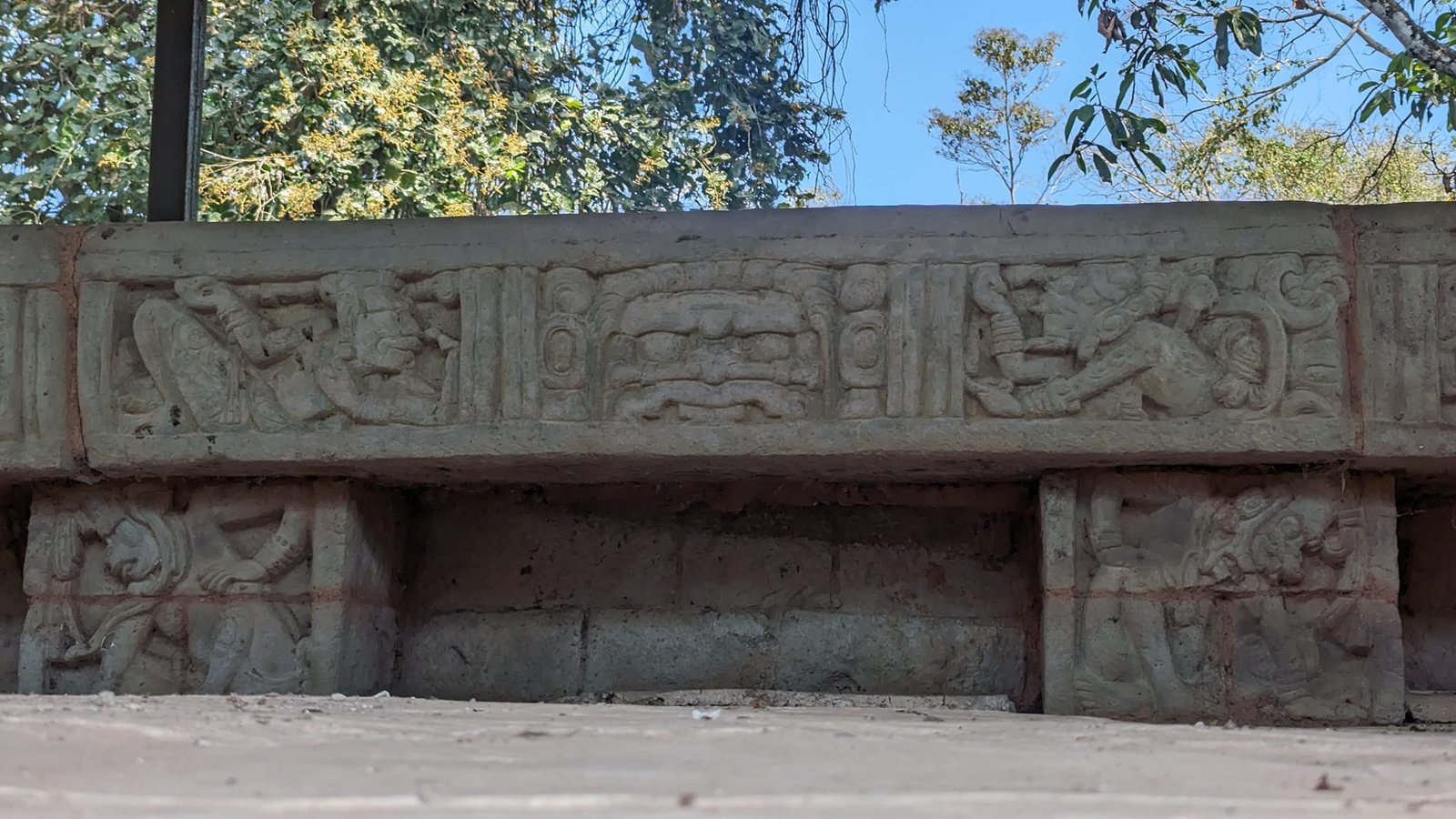
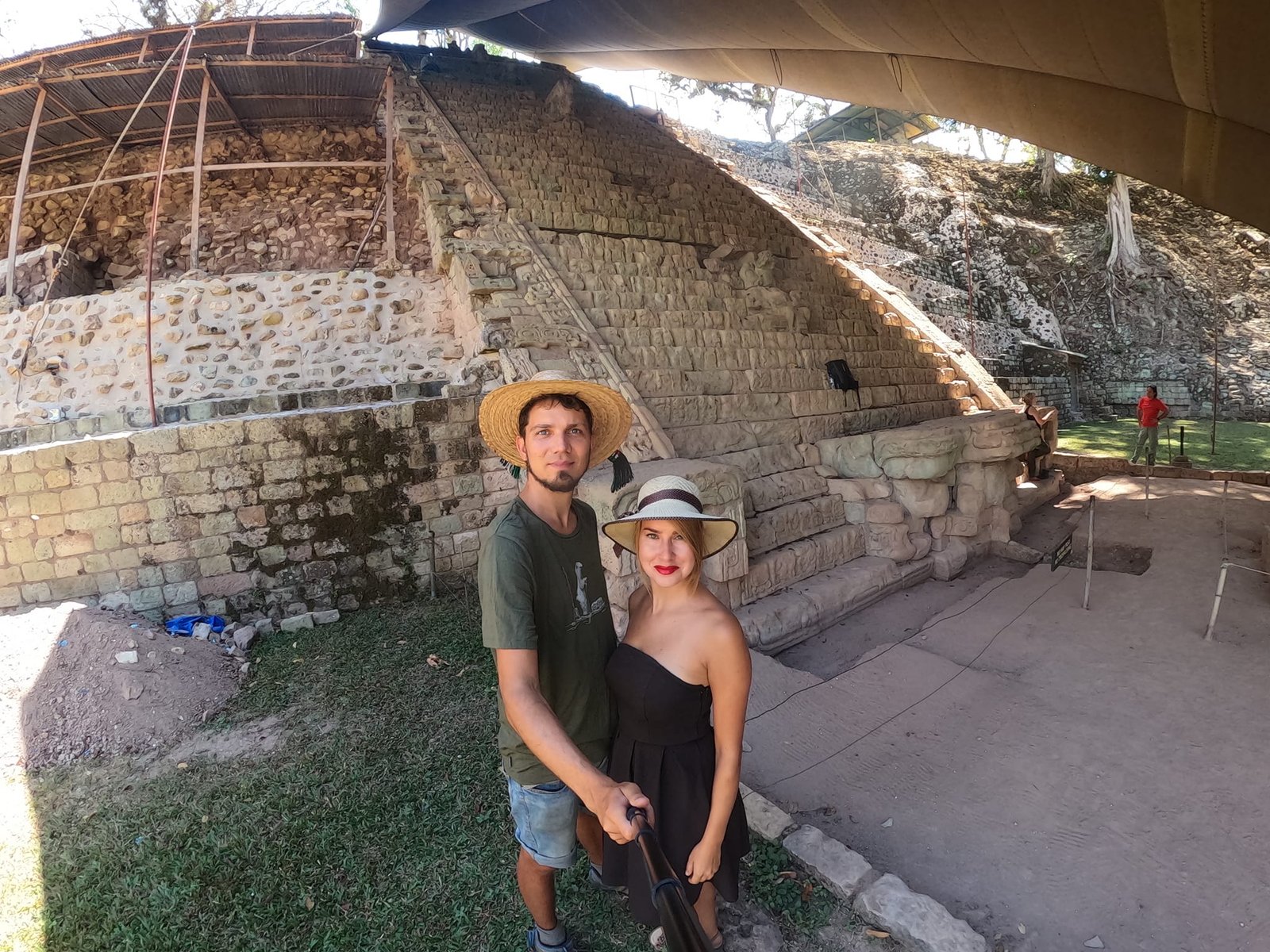
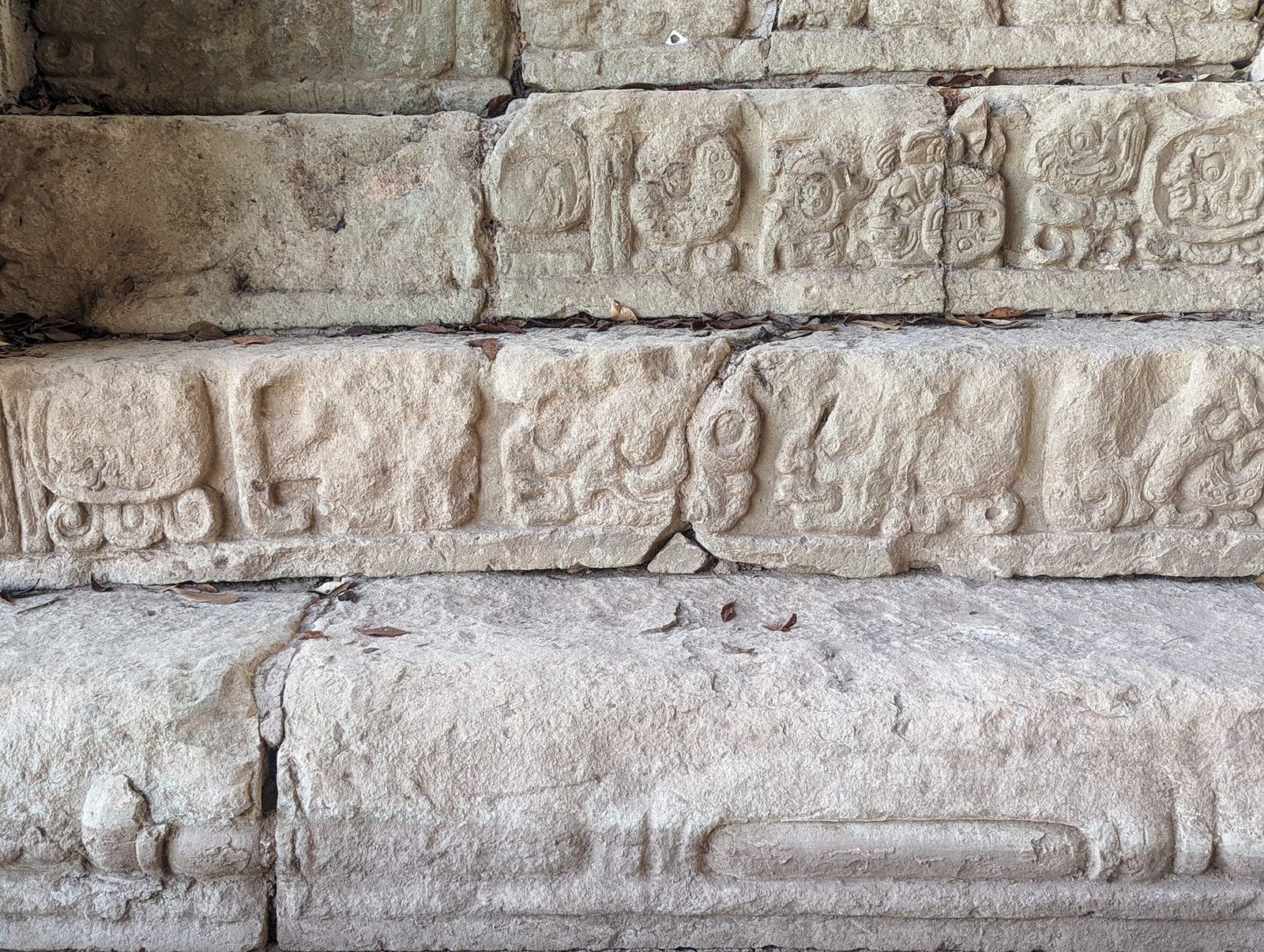
What makes Copán special? Above all, the Hieroglyphic Stairway: 63 steps carved with about 2,500 glyphs telling the history of the city’s successive rulers. It is the longest monument of its kind in the Americas and the most important surviving Maya text. Today the whole stairway is covered by a large roof that protects it from the sun and rain.
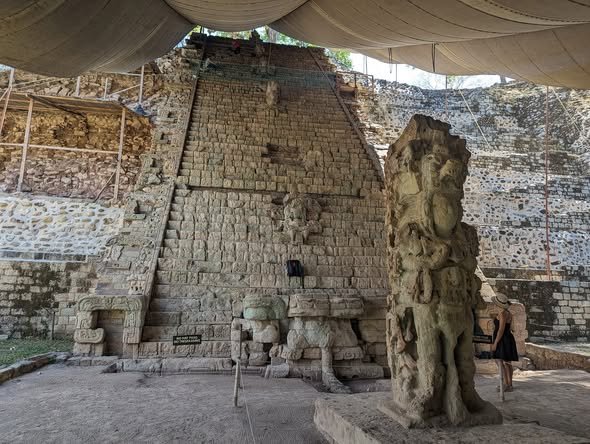
Up close you can see how densely it is covered with glyphs – every step is another fragment of a story carved in stone.
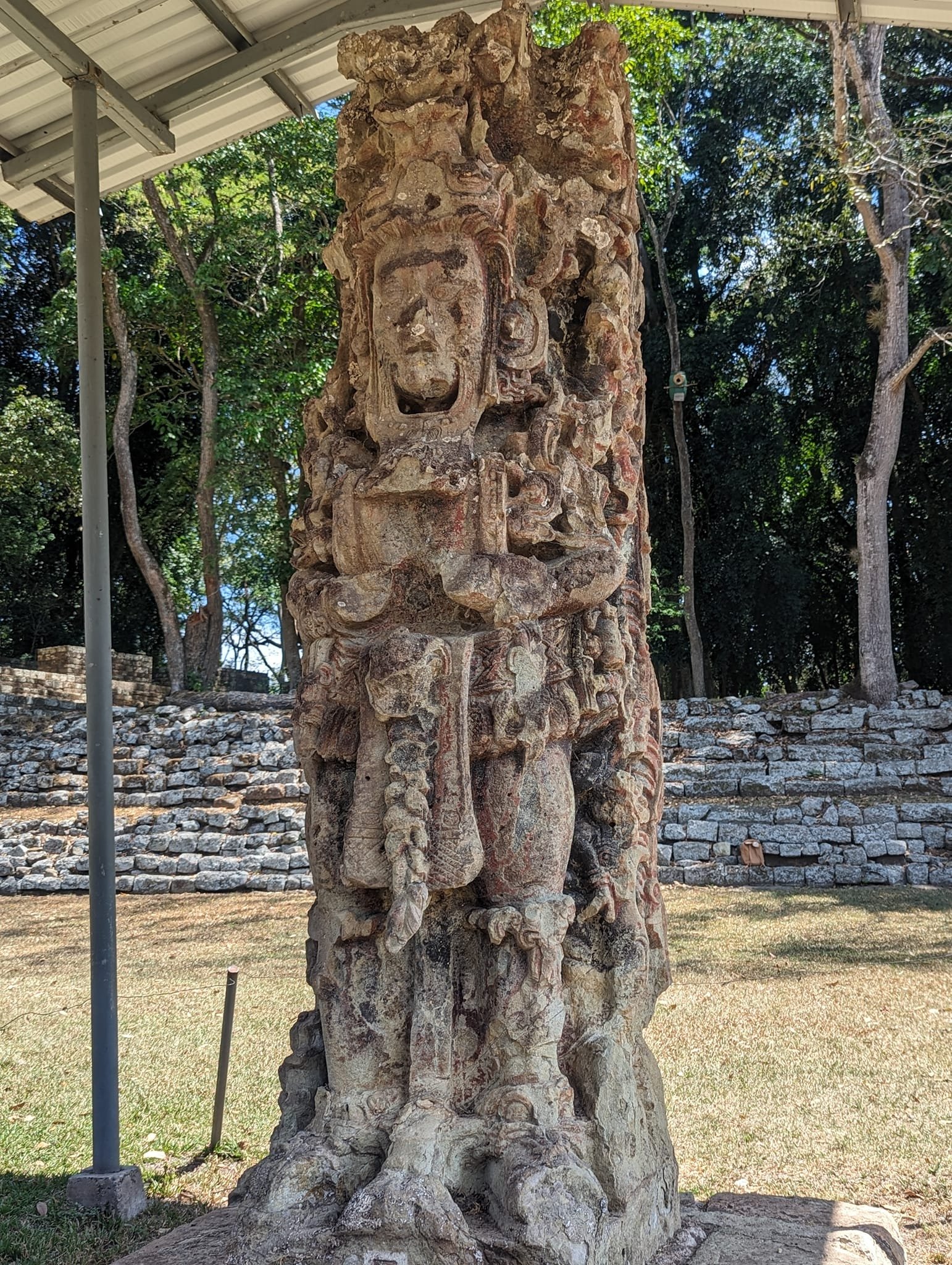
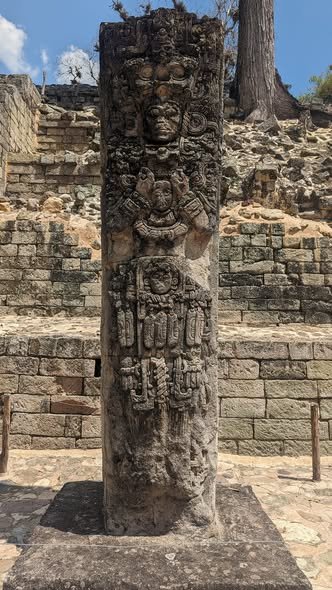
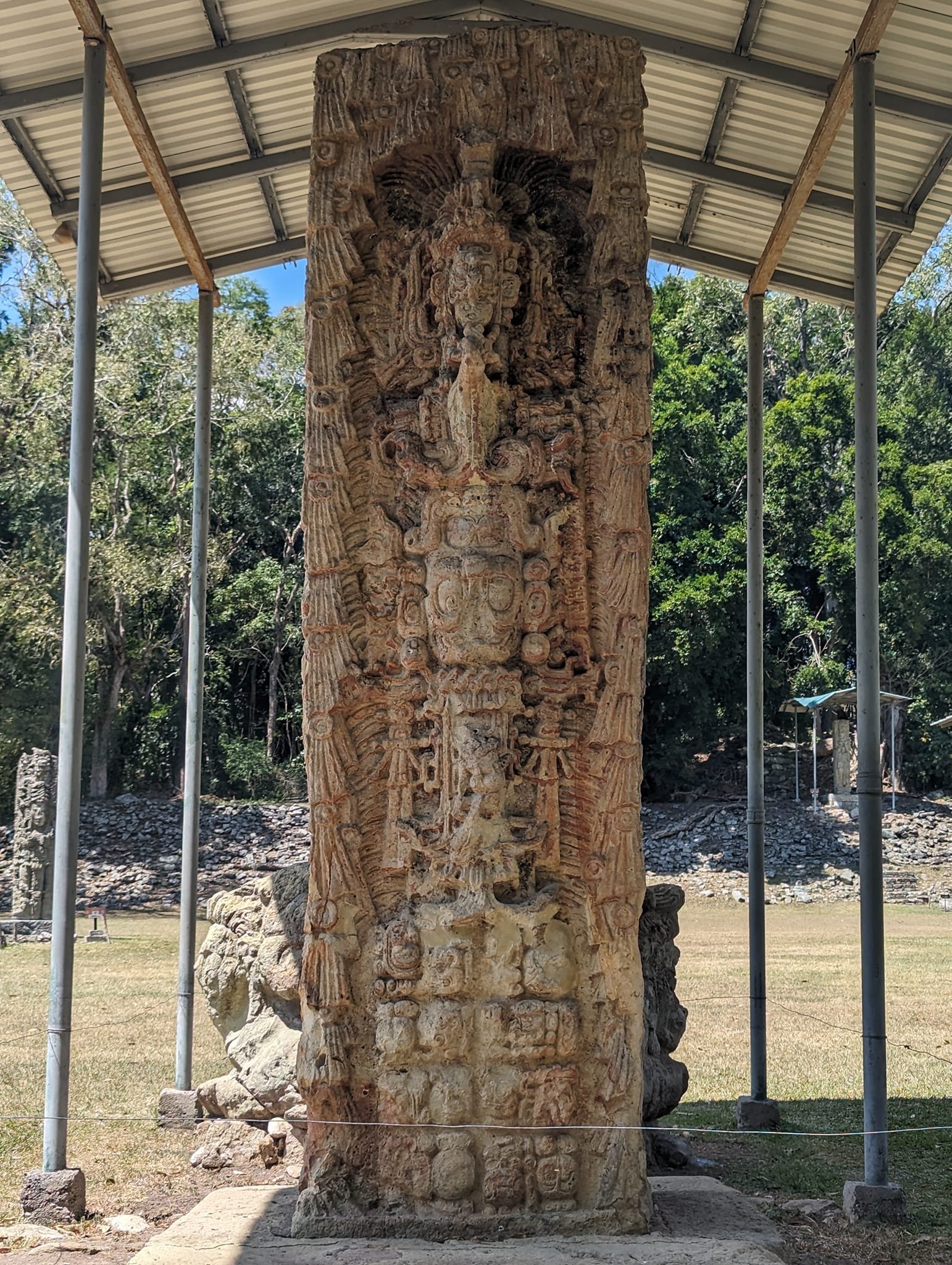
Copán’s second hallmark is its stelae – stone monuments of rulers in ceremonial dress. There are loads of them here – they are densely covered with carvings, and many stand on the plazas under their own little roofs.
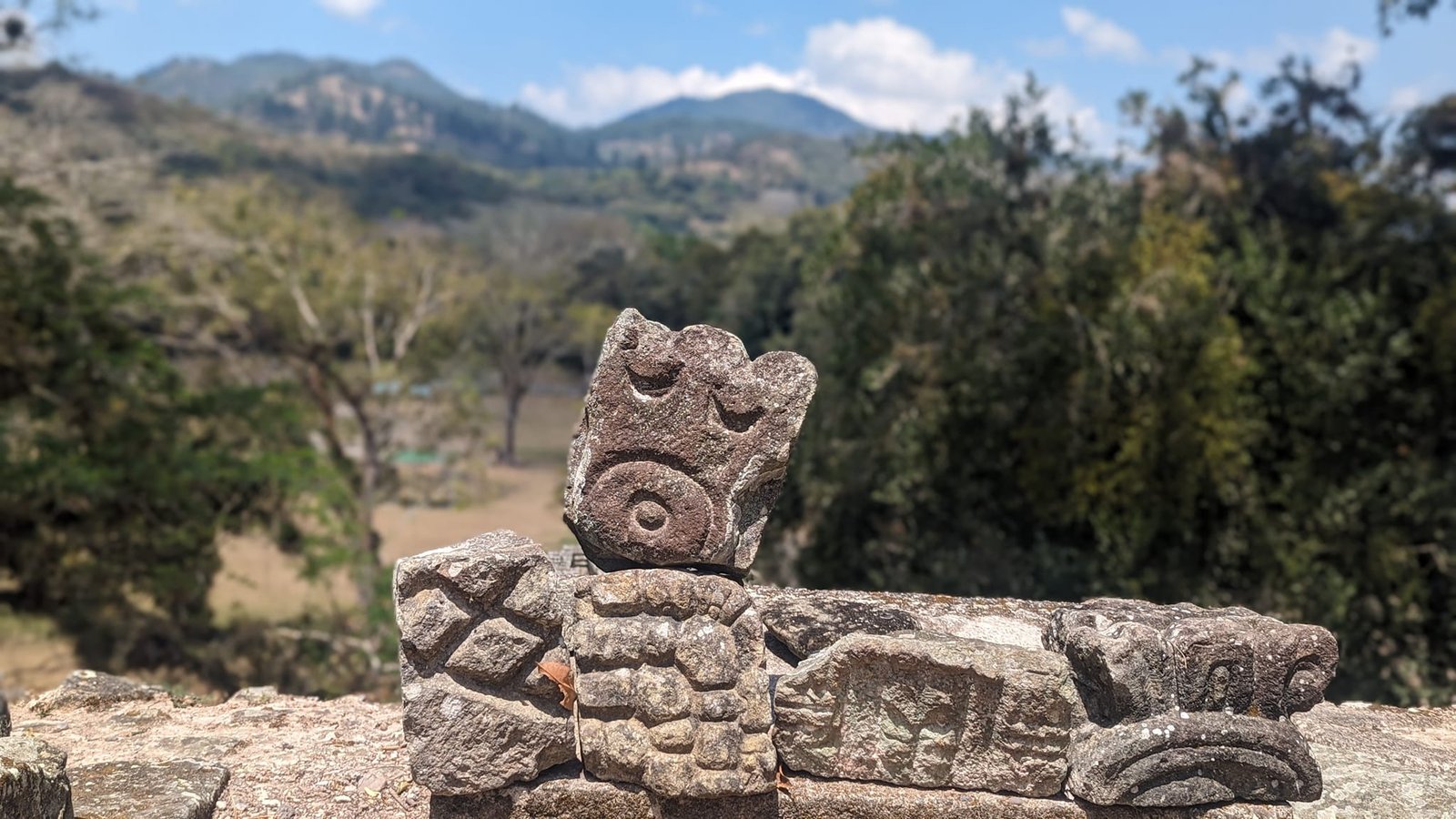
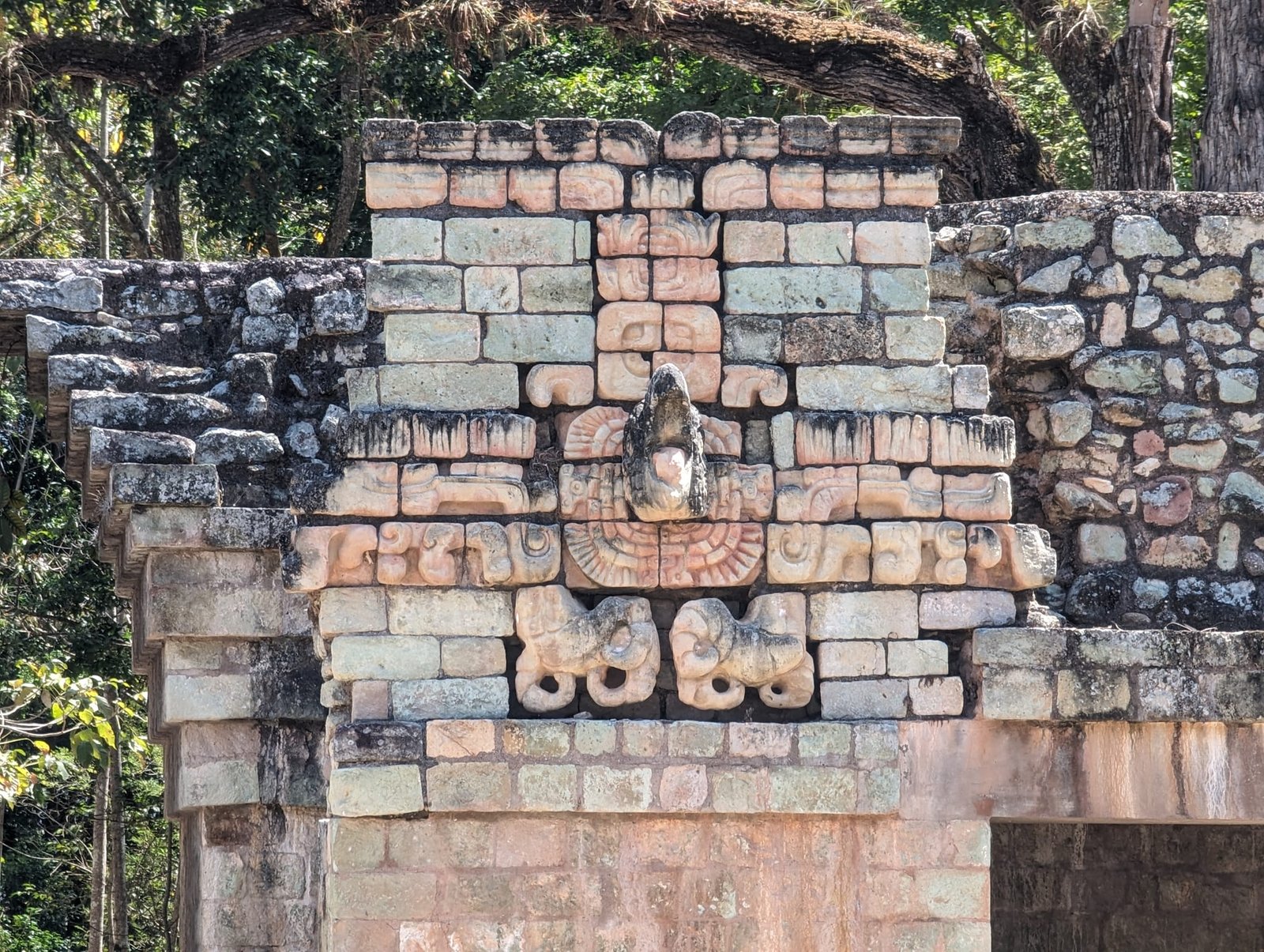
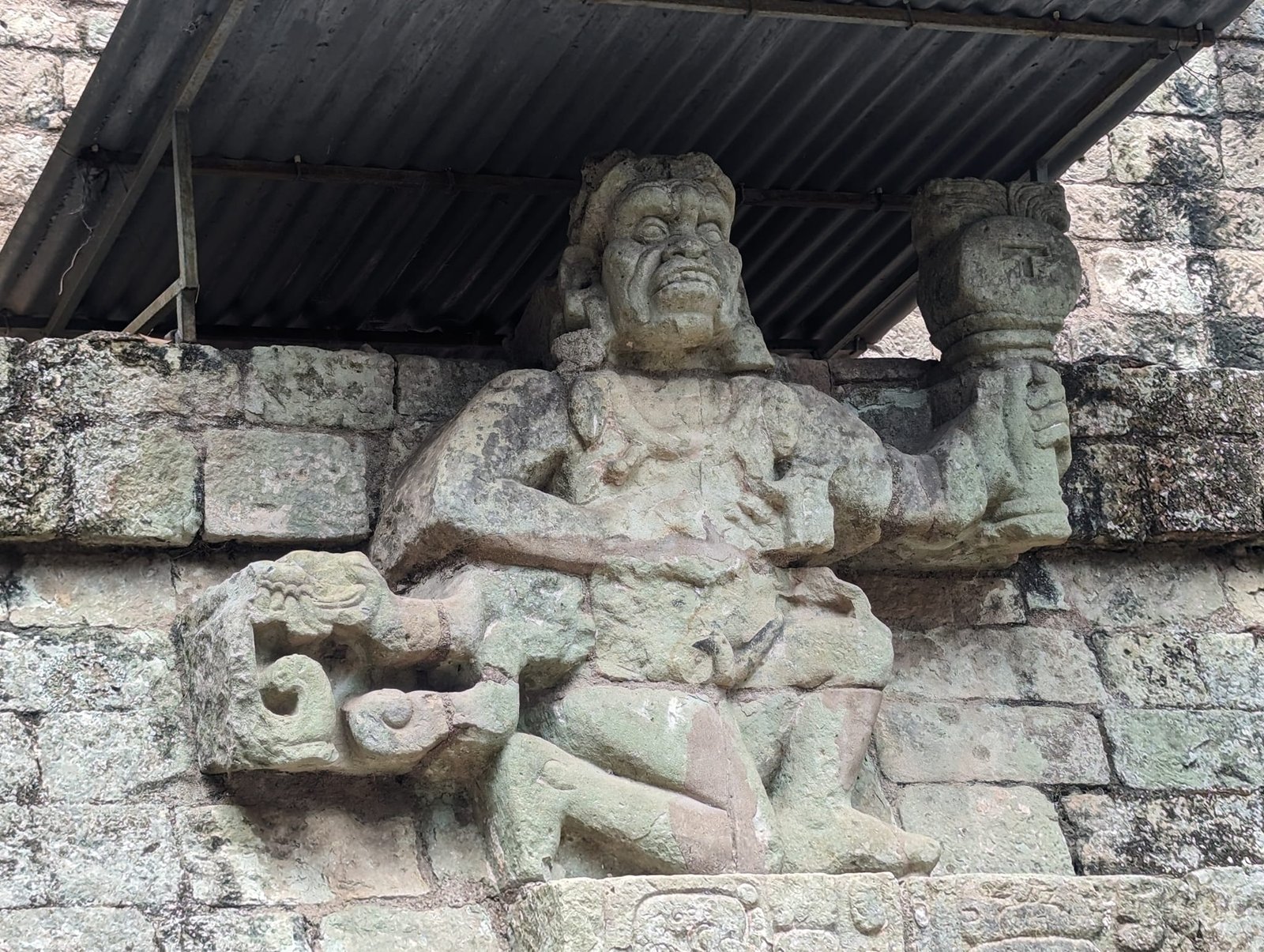
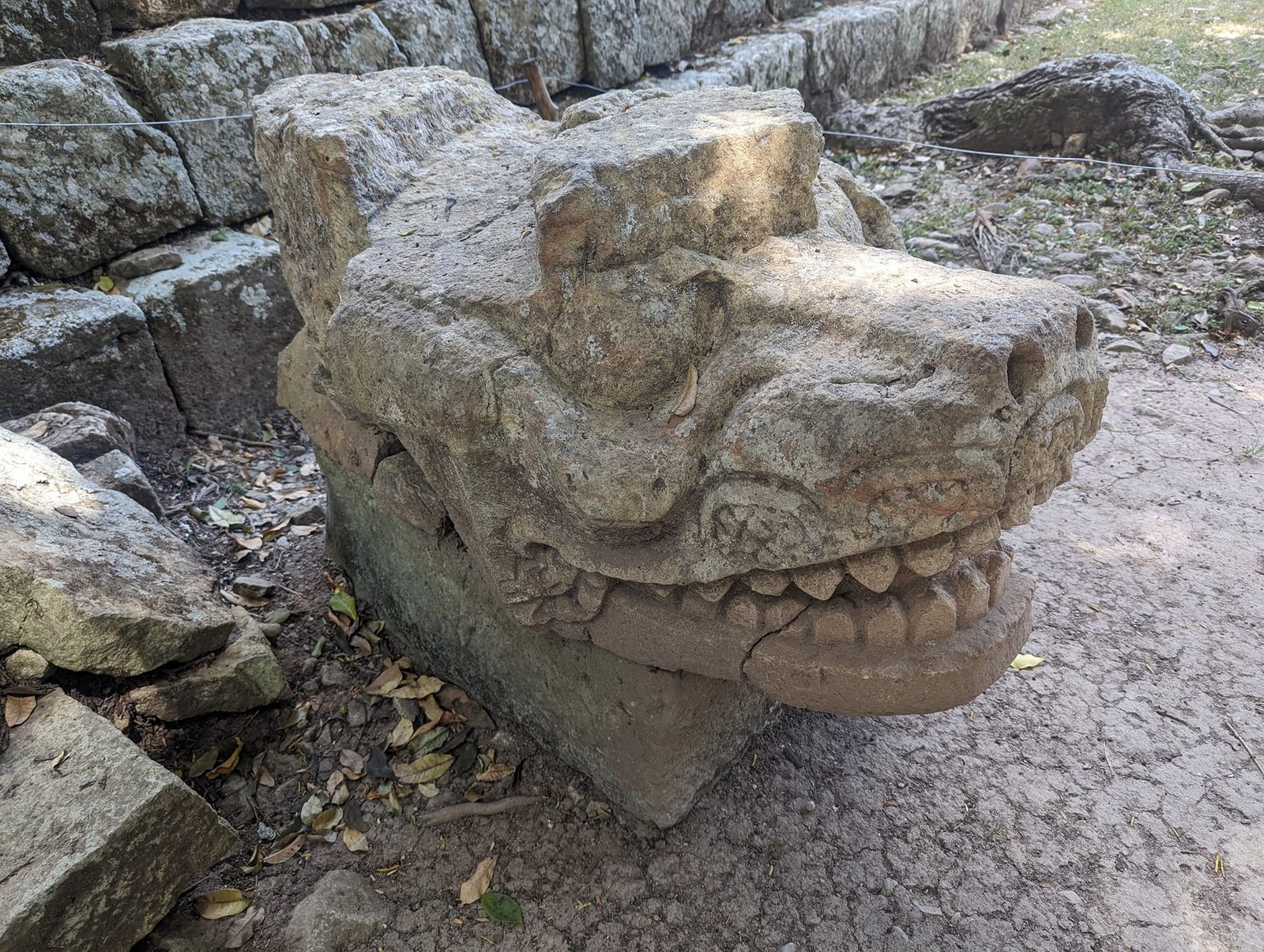
There are many more sculptures: figures set into the temple walls, stone heads and animal masks. At every step you come across another stone detail.
The ball court and scarlet macaws
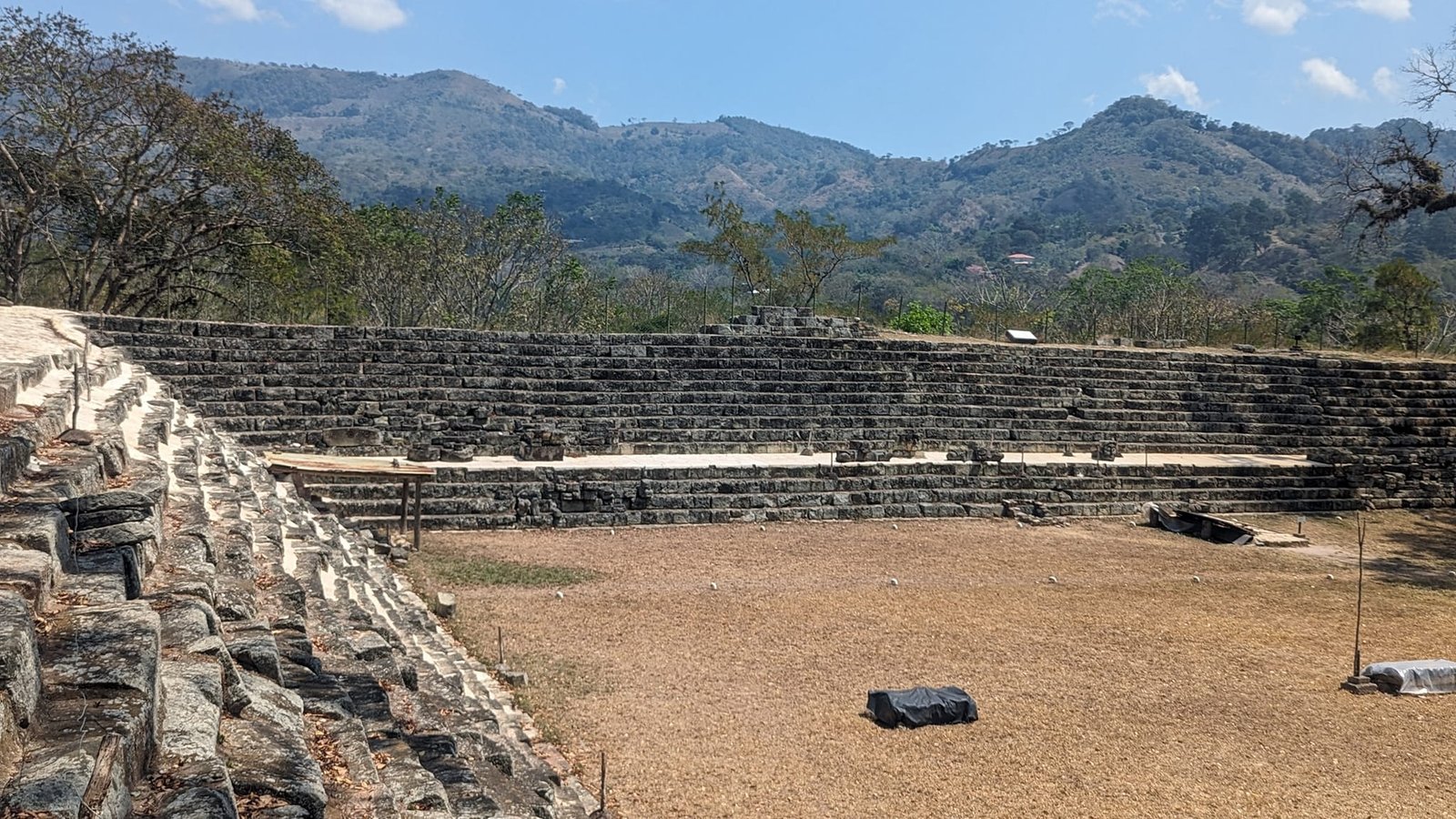
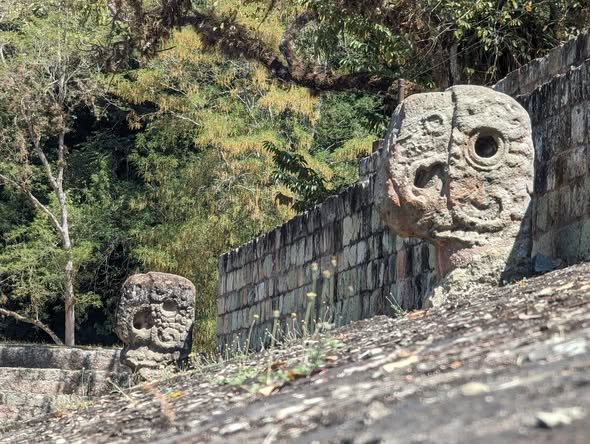
The “icing on the cake” for us was the ball court (juego de pelota), whose markers are shaped like macaw heads. So what was the game about? Using their hips and thighs, players had to keep the ball in the air so as to get it through one of the stone rings set several metres above the ground (we had seen rings like that earlier on the huge ball court in Chichén Itzá). Quite often the stake was… the players’ lives.
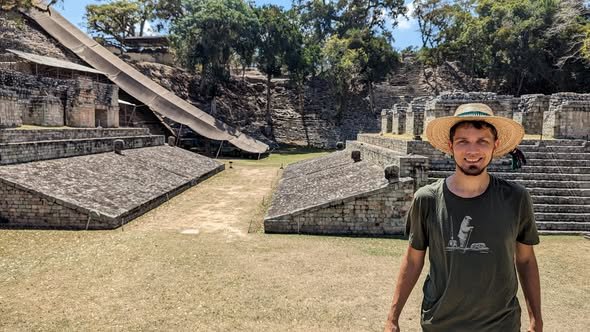
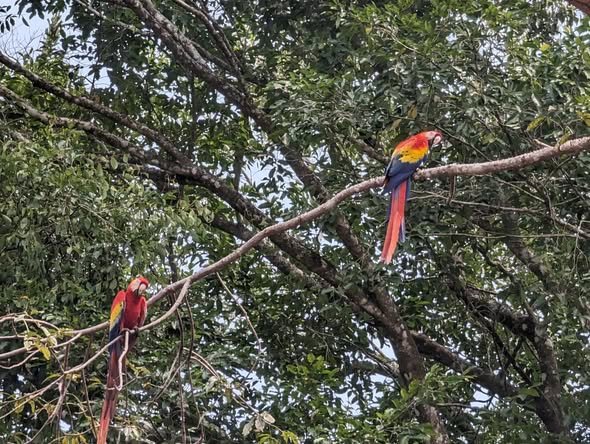
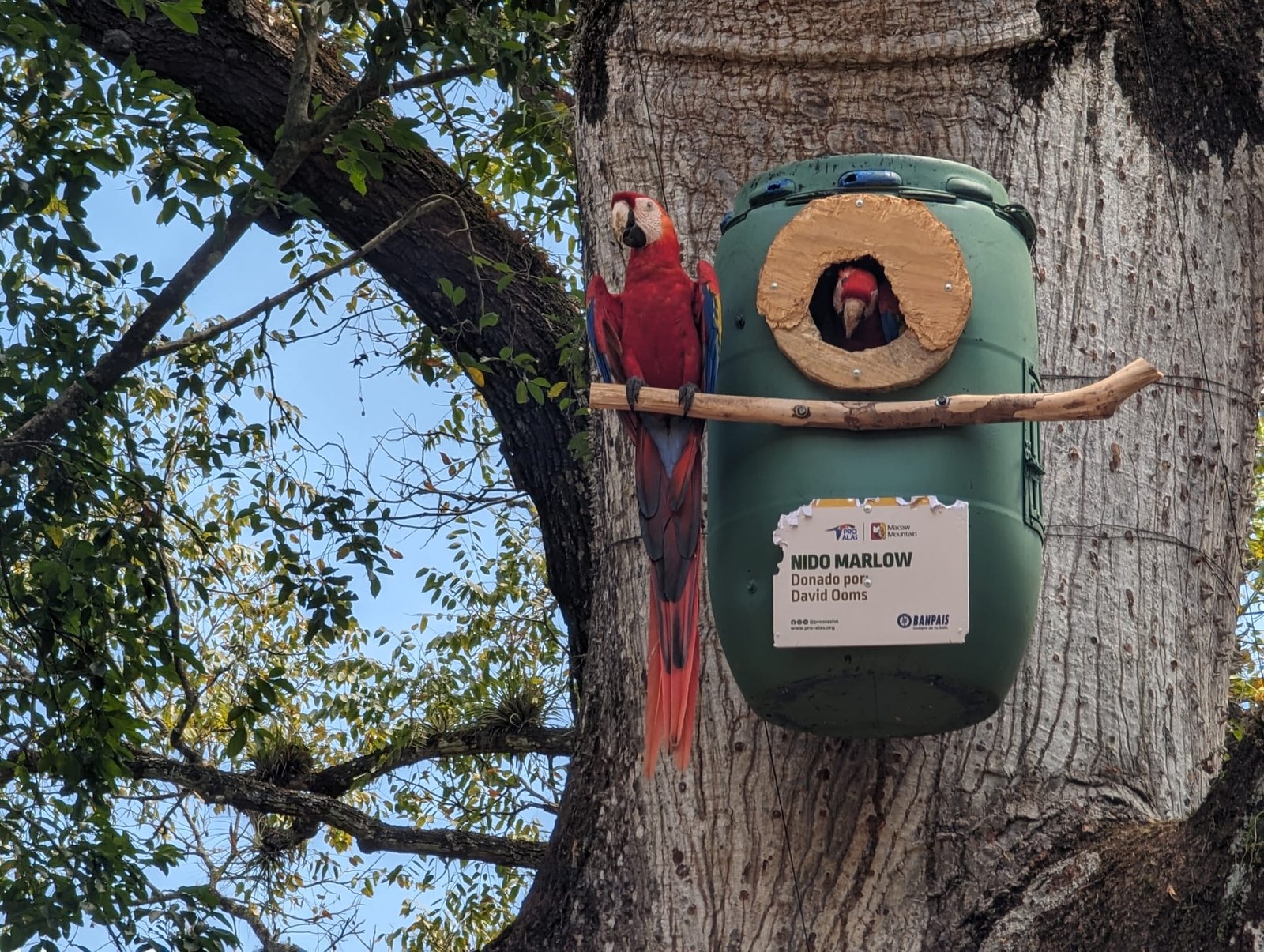
The macaws here are not just a motif carved in stone, though – these colourful parrots live completely freely within the ruins. They sit in the trees above the plazas, and by a nest box hung on one of the trunks we managed to see a macaw really close up.
Tickets and visiting
An entrance ticket to the archaeological zone for foreigners costs 20 USD / 500 HNL. For an extra 15 USD you can visit the tunnels under the pyramids, and for 10 and 5 USD you can enter two museums. We felt that this was no longer cheap, and with all the extras it would have been very expensive – so we went for the basic option. Our ticket also included entry to the Las Sepulturas complex, about 1.5 km from the main area (prices from March 2024).
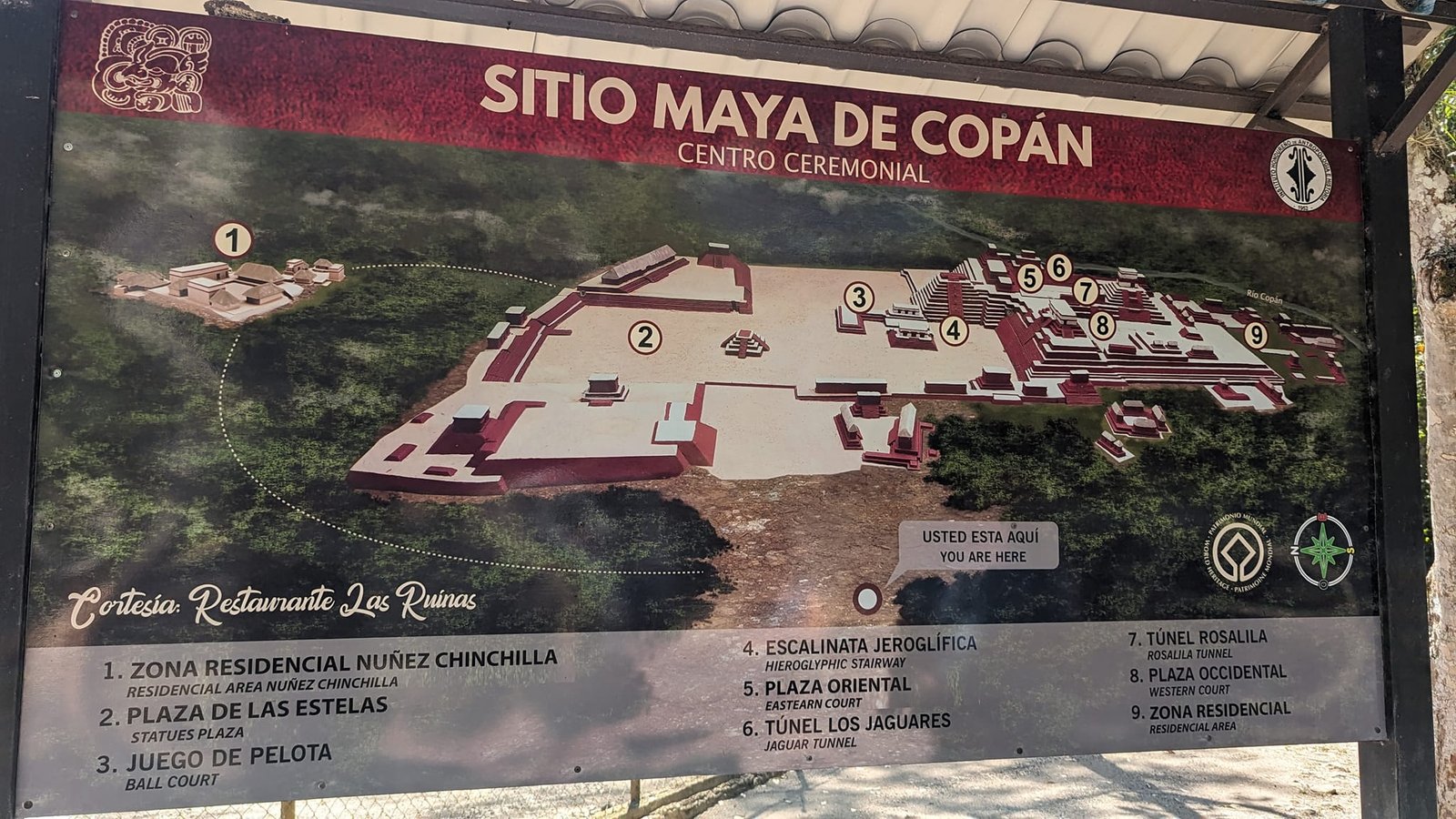
Along the way we passed boards with a plan of the archaeological zone – they come in handy, as there are quite a lot of plazas and buildings here. We spent a few hours on the main part of the ruins and Las Sepulturas: we went in in the morning and were back in town by early afternoon.
The town of Copán Ruinas
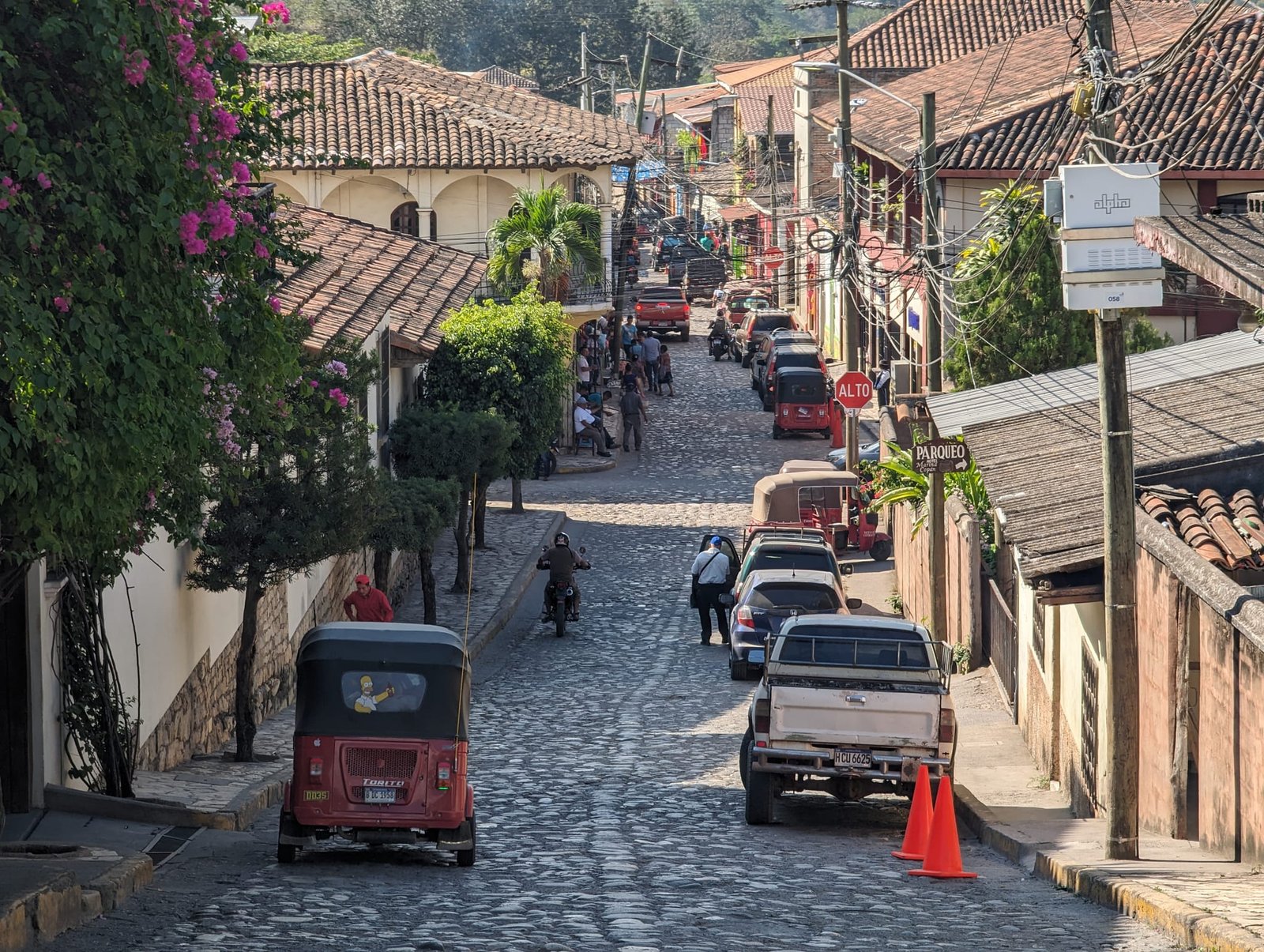
Copán Ruinas is a small town right next to the ruins – one of the few places in Honduras considered safe. It is touristy enough that we had no worries about safety. And indeed: it didn’t feel like Honduras at all, and even after dark everything was fine.
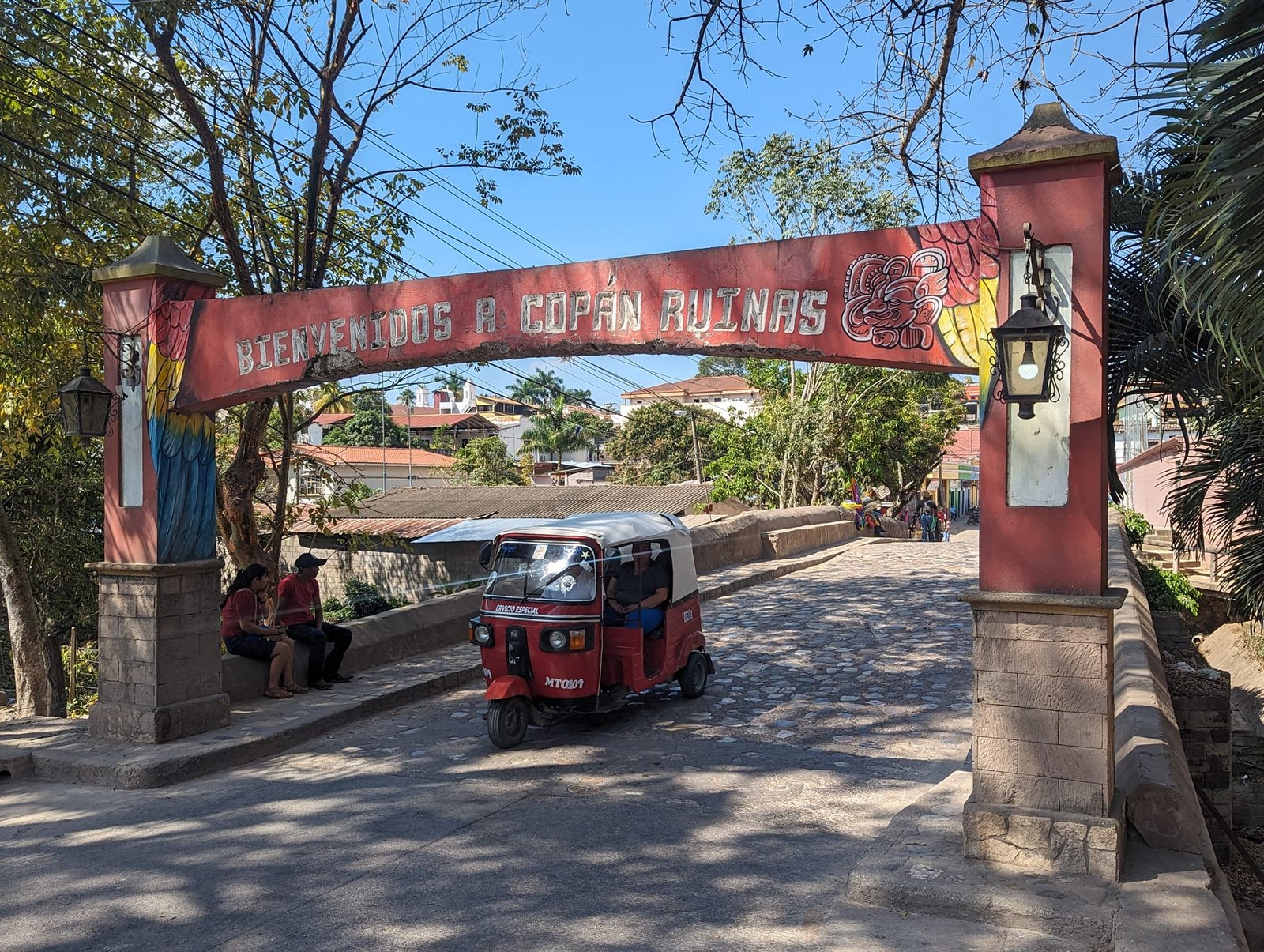
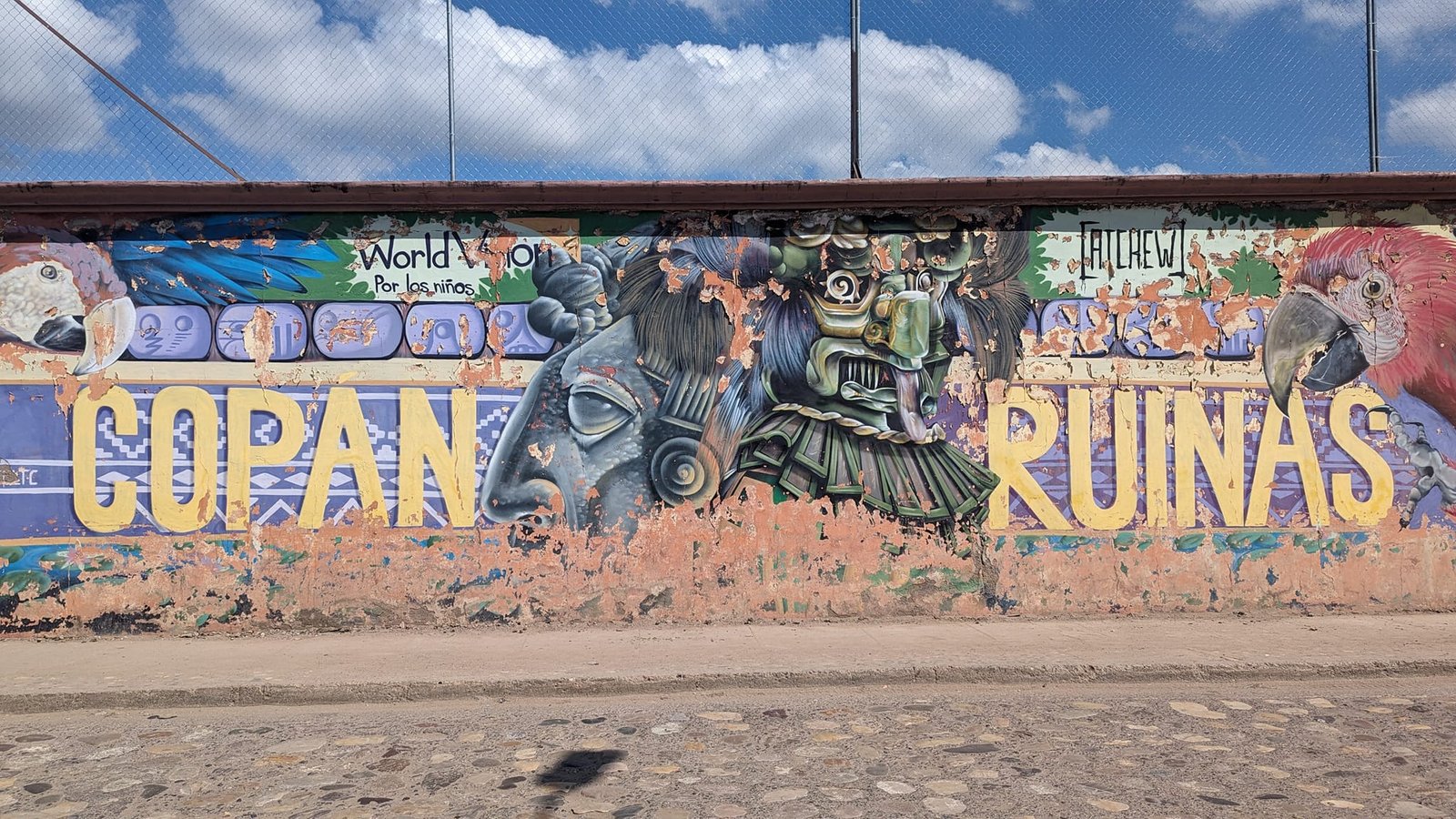
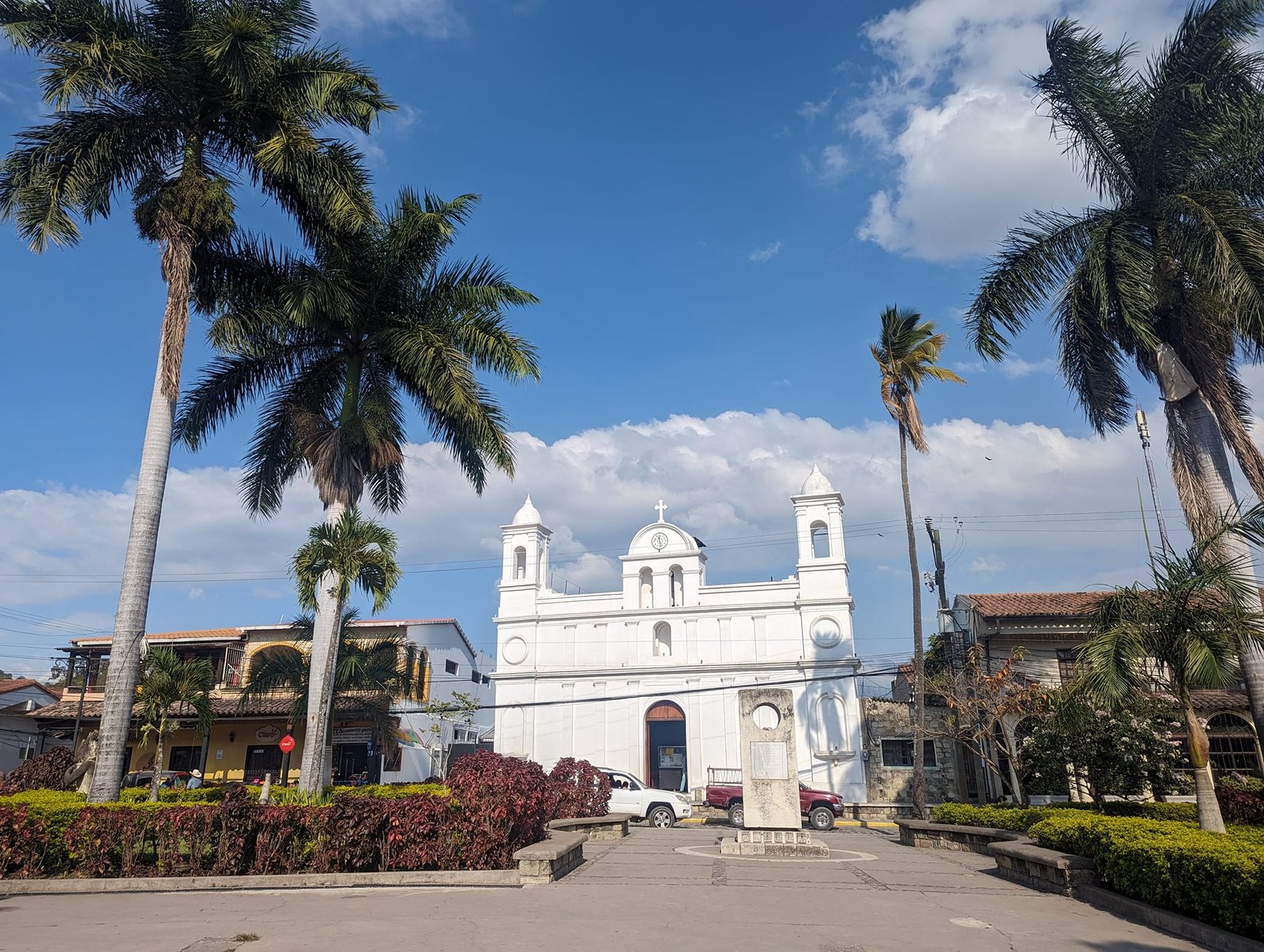
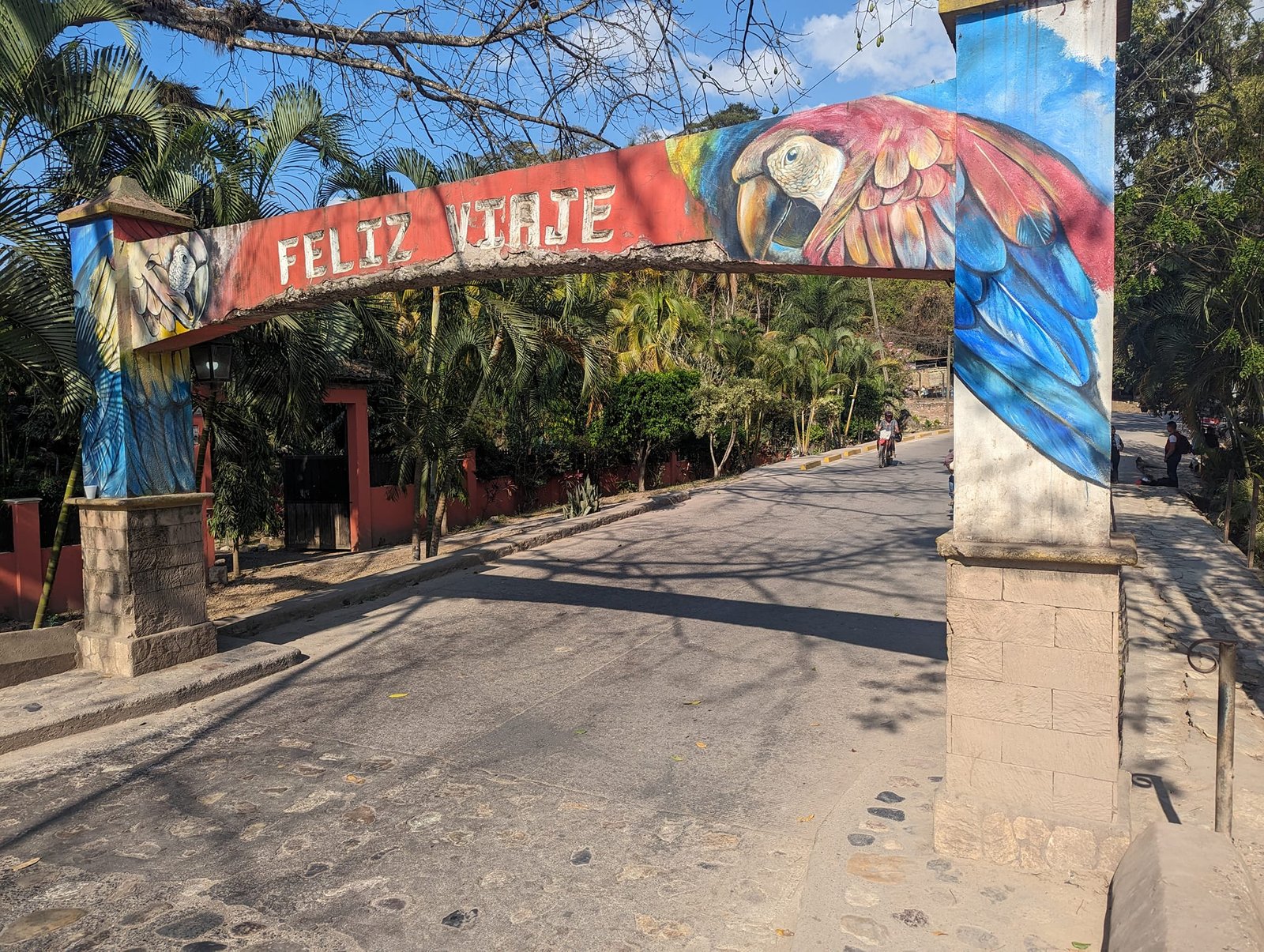
Red tuk-tuks drive along the cobbled streets, colourful murals of macaws decorate the walls, and in the centre there is a park with a white church and palm trees. We stayed here for two nights – we arrived in the evening of 29 February and moved on in the morning of 2 March.
Getting there from El Salvador via El Poy
We came to Copán Ruinas from El Salvador. To save money, we travelled from San Salvador on our own rather than by direct shuttle (although that would have been twice as fast). We set off at 6:30 and arrived at 18:30 – 210 km, 4 buses in total, via the El Poy border crossing. We had no problems at the border; you only have to pay 3 USD to enter Honduras. This way, instead of 65 USD for the shuttle, we paid 15 USD each. From the border onwards it was very green and really beautiful – Honduras’s landscapes reminded us a lot of El Salvador.
How I accidentally crossed the border “illegally”
After crossing from El Salvador into Honduras, in the very next town past the border I realised that I had left my bum bag in the toilet at a petrol station on the Salvadoran side. I quickly jumped on a bus going back. At the border I explained the situation: first I was told that I didn’t need to sort anything out at the Honduran immigration office, then I explained the same thing to the people collecting the slips for the Salvadoran exit fee. At the Salvadoran immigration office they were very surprised to see me again – I left my passport with them for safekeeping, and luckily the bum bag turned up.
On the Salvadoran side everything went smoothly after that, but on the Honduran side they stopped me: first I was supposed to go to the immigration office. I explained the situation and showed the slips from Honduras. The officer said that “you can’t do that”, but she didn’t know what to do with me, so in the end she let me through. Afterwards I was still a bit worried, because the police checked our bus twice and both times the same police officer picked up precisely my passport.
Safety in Honduras and the onward journey
Honduras is not one of the safe countries. Visiting San Pedro Sula and Tegucigalpa is discouraged the most, because that is where gangs are most active. We were only in Copán Ruinas, La Ceiba and on Utila, so we can’t speak about the rest of the country. Travelling by public bus from the border at El Poy to Copán Ruinas, and then on to La Ceiba, was trouble-free. Compared with the neighbouring countries, though, places close early here, and in La Ceiba almost everything was shut after dark and the streets were empty. For comparison: in El Salvador, despite its bad reputation, we felt safer than in Guatemala or Honduras.
We left Copán Ruinas on the morning of 2 March – by bus to La Ceiba on the Caribbean coast, from where we took the ferry to Utila the next day. There we did a diving course and stayed two weeks instead of one – I describe it all in the post about Utila. From Honduras we then went straight to Nicaragua.
Practical information
The key information in a nutshell (prices from late February and early March 2024):
- Route: San Salvador → El Poy border crossing → Copán Ruinas → La Ceiba → ferry to Utila, and after two weeks a night shuttle from La Ceiba to León in Nicaragua.
- Entering Honduras: 3 USD at the border. As Polish citizens we didn’t need a visa – you can stay in Guatemala, El Salvador, Honduras and Nicaragua for up to 90 days in total. How we extended our stay is in the post about Utila.
- Copán ruins: 20 USD / 500 HNL (including Las Sepulturas), tunnels under the pyramids +15 USD, museums 10 and 5 USD.
- Currency: the lempira (HNL); in March 2024, 1 USD got you about 25 HNL.
- Costs: over 20 days in Honduras we spent on average 19 USD per person per day (accommodation, food, local transport and attractions), or 33.5 USD including the diving course.
- Food: as in Guatemala and El Salvador, flatbreads with various fillings and fried-chicken chains are popular, and a typical lunch is red beans, rice and chicken. The cheapest are baleadas – traditional Honduran filled wheat tortillas.
- Safety: Copán Ruinas, La Ceiba and Utila are considered safe; San Pedro Sula and Tegucigalpa are best avoided, and don’t walk around empty streets after dark.
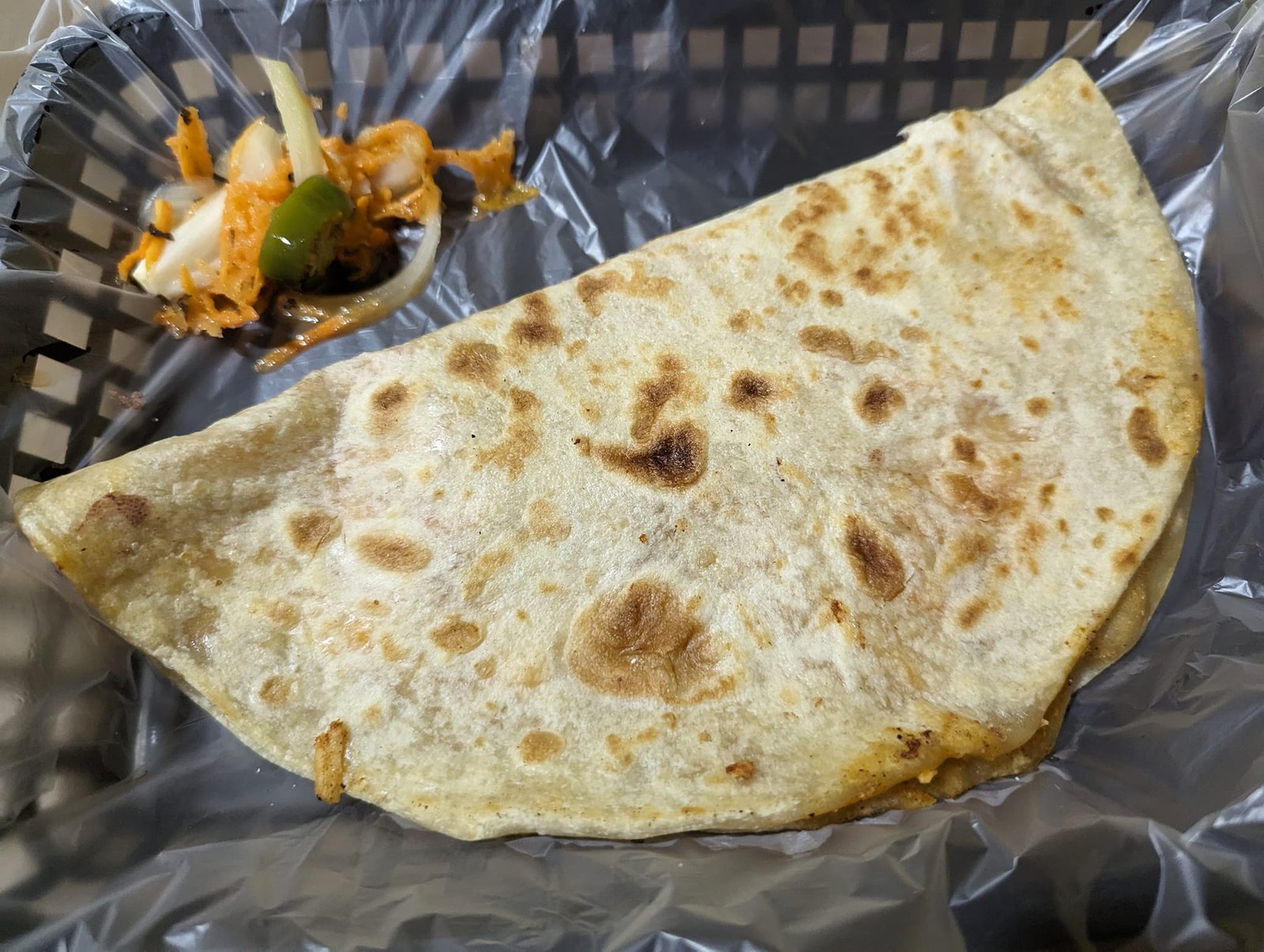
Photo gallery