 6:57

Sacramento is the capital of California. It offers many attractions, including lots of museums and a large number of theatres. During the great Gold Rush the city was an important economic hub and the western end of the first transcontinental railroad. That is exactly the atmosphere of the old part of the city, which is reminiscent of the Wild West. Strolling along the beautiful cobbled streets, looking at horse-drawn carriages, old buildings, wooden crates and whisky barrels, you really do feel like you’re in a western.
We visited Sacramento during the same week-long break from work in Yosemite as San Francisco – the fire had emptied the park and there was no work. Despite the short distance between the two cities, Sacramento was much warmer than chilly San Francisco.
Pioneers settled at Sutter’s Fort around 1841. The fort’s main building is the only surviving original structure in the reconstructed Sutter’s Fort State Historic Park. It was here, in 1848, that James Marshall met Sutter to show him the gold Marshall had found while building Sutter’s sawmill on the American River. After news of the Gold Rush spread, the fort was largely abandoned and fell into ruin. In 1891 the organisation The Native Sons of the Golden West bought the property and saved the monument from destruction. Repair work was completed in 1893. In 1947 the fort was handed over to California State Parks.
The fort was founded in 1839 by John Sutter as the farming and trading settlement of New Helvetia (Nueva Helvetia) in what was then the Mexican province of Alta California. In 1961 it was designated a National Historic Landmark.
It is the oldest existing cemetery in Sacramento (from 1849). Many of these 19th-century graves belong to people who died during the cholera epidemic – in 1850 a mass grave for its victims was made here. Among others, John Augustus Sutter Jr. (1826–1897), the founder of Sacramento and son of the founder of the fort, is buried here. The cemetery is a listed monument and was designed to resemble a Victorian garden.
It is the most important Catholic church in the Diocese of Sacramento, the seat of the bishop and the largest historic cathedral on the West Coast of the United States (from 1889). The building was designed in the Neo-Renaissance style, inspired by Italian architecture.
The park by the Capitol is quite large – it covers 40 acres and was laid out in a typical Victorian style, with long paths and varied plants. It has the World Peace Rose Garden. The park also has many memorials (the California Peace Officers’ Memorial, the Vietnam Veterans Memorial, the Thomas Starr King monument and the Pioneer Camellia Grove memorial stone).
The building was built in the Neoclassical style; it stands at the western end of Capitol Park, surrounded by gardens and palm trees. It is the seat of the state legislature.
The building also houses an impressive museum, where you can see quite a few rooms, including the offices of former governors and the treasury. There are also free guided tours (about 45 minutes).
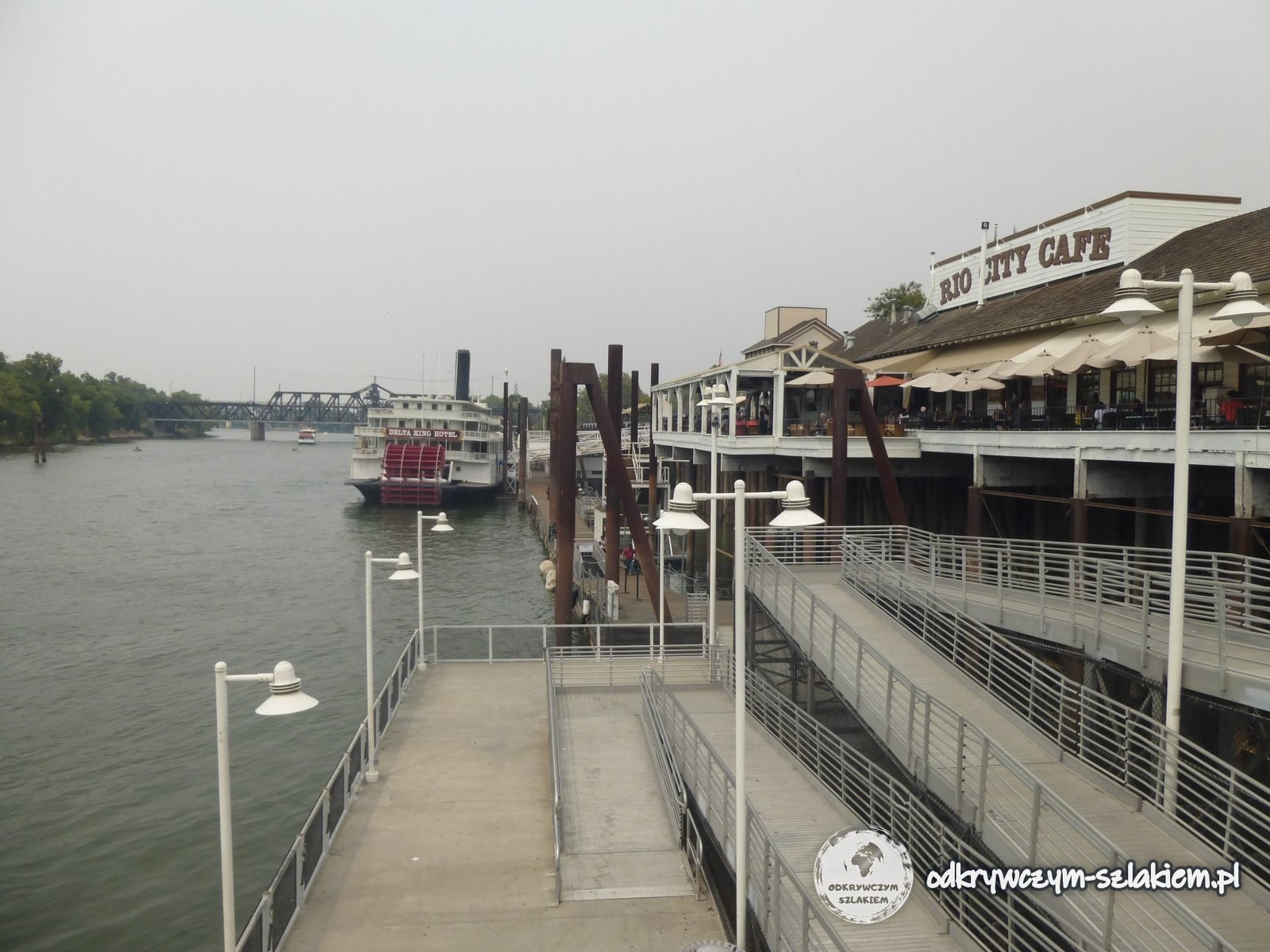
In this part of the city you will find the building of the oldest permanent theatre in California (Eagle Theatre) and the first seat of the state supreme court. You can also see architecture from the Gold Rush era (the district was restored in the 1960s) and the Big Four House – the building of the “Big Four”, the pioneers of the transcontinental railroad. Horses with carriages move along the cobbled streets, which gives the place a lot of charm. If you like, you can take a ride on a steam train or a boat trip on the river.
The history of Sacramento is also linked to the railways. By Old Town there is the California State Railroad Museum, where you can admire historic locomotives, some dating from as early as 1862. You can also take a ride on a vintage train of the Sacramento Southern Railroad, which operated from 1909 to 1978.
On 30 July we returned from Sacramento to Yosemite – the park was supposed to reopen “90%”. Because of the fire only one road from the west was open, and the free staff bus ran once a day from Sonora. We took public transport to Modesto, and from there an Uber (45 USD for two people) – and caught the bus at the last minute. There was as much smoke in the park as on the day we had left, and Yosemite looked like a ghost town: the tourists and some of the workers had already left. A few days later we were evacuated – I write about it in the post about working in Yosemite.
6:57Stay with me on the road – follow me wherever you like best.