Bulgaria (the coast), with its beautiful sandy beaches, good weather and attractive prices, is a destination we like too. With limited time we only visited its eastern part, but the mountainous areas, which make up most of Bulgaria, undoubtedly deserve attention as well. On our trip we visited, in turn, Burgas, Sozopol, Nesebar, some “wild beaches”, and then Varna and Balchik.
In August 2020 we flew into Varna, and from there went straight on by bus from the central bus station (a ticket cost 14 LEV per person at the time) to Burgas. Honestly – it didn’t impress us. It did have the nice Bogoridi Boulevard, the street by the town hall (“Svoboda” square), a few Orthodox churches (including Saints Cyril and Methodius), the long seaside park (the Sea Garden) and a few beaches (it’s worth walking along the pier). But you can still feel the communist times there (“Burgaska Komuna” square, the “Alyosha” monument).
Sozopol, on the other hand, was a pleasant surprise: apart from spending time on the beach, we could stroll through the atmospheric streets of the old town past the many wooden houses, tasting wine here and there. You will find a few ruins there, as well as the ancient town wall. It’s worth stopping at the Church of Saints Cyril and Methodius, the Chapel of Saints Constantine and Helena, and going out to Cape Skammi by the water. Right next to Sozopol there is an abandoned military base, which you are not allowed to enter.
Nesebar (Nessebar) has a similar atmosphere, although it is far more important historically. We got to admire, among other things, the ruins of fortifications and churches – the oldest dates from the 4th/5th century (the Church of St Sophia), but most were built after the 10th century. The ancient part of the town is on the UNESCO World Heritage List.
In the eastern part of the town there are two paid car parks, but they can be full. Because it was close to our hostel, we parked in the western part, at the car park at Pliska Street 8 – we paid 8 LEV for 24 hours. Unfortunately, despite circling the area several times, we didn’t find a single free parking space.
As for beaches, a much more interesting option was to go to the wild ones. Especially worth recommending is Irakli (плаж Иракли, between Burgas and Varna, not far from road no. 9). There, though, the one thing missing to make us completely happy was a tent. As the place has neither public transport nor much accommodation, a lot of people wild camp, often right by the water. This beach is especially for people who prefer close contact with nature and peace and quiet. Because of that, especially in season, it can be considered a real gem. We walked about 2 km south along the beach, to shortly before it narrows completely (marked on Google Maps as Плаж Елените) – a whole day of relaxing, no electronics, almost nobody around – we recommend it. In the northern part there are free showers and toilets (Vaya beach). That day the air temperature was 32 degrees and the water 28 (end of August).
Over the last few years the area has seen some investment – among other things, the paid Camping Irakli, apartments by the water (Vaya Beach Resort), a free car park and a few places to eat have been built. In season it’s good to arrive at the car park early enough, because it fills up quickly – arriving at around 12/1 pm, we barely managed to find a space, and lots of cars were still circling around looking for one. Most people leave before dark, though, which is why the photo taken the next morning shows an almost empty car park (we slept in the car). The rest park along the dirt roads a little further south – around Camping Irakli Wild.
The second beach we visited was Shkorpilovtsi. It didn’t have such a great atmosphere – the tourist infrastructure around it is much more developed – but don’t be surprised if, on the way there, you see horse-drawn carts on the road :).
Because of the coronavirus situation, we couldn’t complain about crowds anywhere. Even on the most touristy beaches there was plenty of room to spread out a towel.
The city of Varna, where we started and finished our Bulgarian adventure, was one of those places that, like Burgas, didn’t really impress us. It’s a typical tourist city whose main attraction is the beach, with lots of places to eat and services.
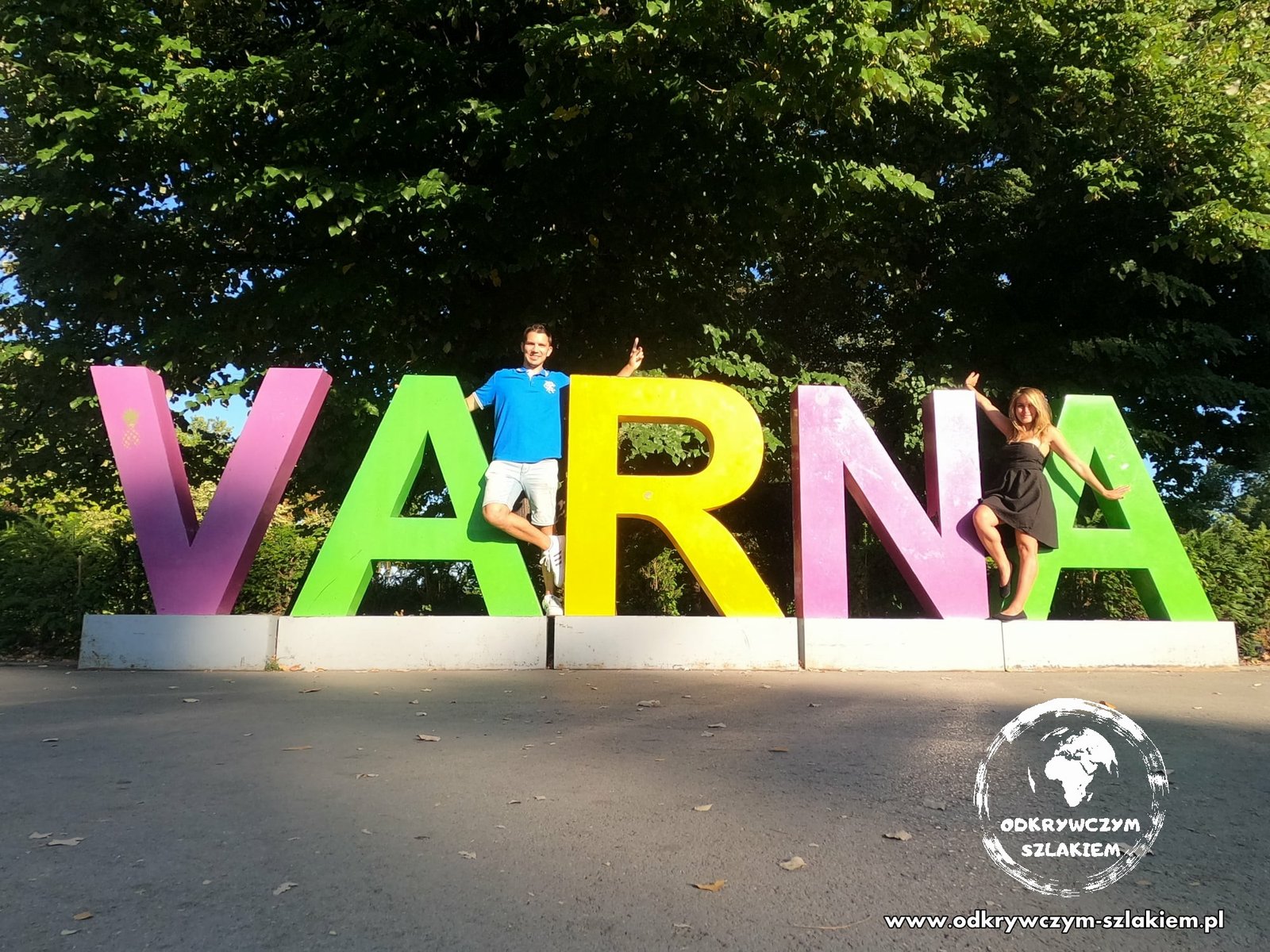
It’s worth going into the Dormition of the Theotokos Cathedral in Varna or the Church of St Nicholas, taking a walk through the Seaside (Primorski) Park, and walking along the port to the lighthouse (stopping on the way at the “Dragons in Love” sculpture). Walking along Slivnitsa Boulevard you can reach the central entrance of the Sea Garden, where there is a square with columns, and behind it the colourful VARNA sign.
In Varna there are also the remains of the Roman baths (closed on Sundays and Mondays) and the Monument-Mausoleum of Władysław III of Varna (unfortunately far from the centre – we ran out of time). Some people also rave about the dolphinarium, but that’s not our thing.
As for sightseeing, a much more worthwhile place in Balchik is the architectural and park complex with gardens (Dvoreca). It was built in the first half of the 20th century. On its grounds you will find the palace of Queen Marie of Romania (Queen of Yugoslavia), residential villas, wine cellars (free tasting), a monastery, a waterfall, a chapel and, above all, a botanical garden with a cactus greenhouse.
It is 40 km from Varna. Transport by bus from Varna’s central bus station costs 5 LEV (as of 2020 – it’s hard to find up-to-date information online, it’s best to check on site). You can enter the grounds from three sides – from the north (Magnolia St), from the west (Momchilov St) or from the south (by the beach). The entrance fee for 2023 is 15 LEV (we also paid extra on site to go into the palace).
Every day we had beautiful weather (28–30 degrees, lots of sunshine) and a warm sea. Back home, reality hit us in rainy and much colder Berlin.
Because of the pandemic there were far fewer tourists, so we could, among other things, easily find a spot on beaches that would normally be crowded.
Sunny Beach and Golden Sands are the most popular Bulgarian resorts, which apart from typical tourist infrastructure have nothing to offer, so we skipped them without any regret (although late one evening we did walk from Nesebar to the southern part of Sunny Beach for a swim). It’s a shame, though, that we didn’t have time for the Kaliakra cliffs (east of Balchik).
Stay with me on the road – follow me wherever you like best.