Skip to content Skip to sidebar Skip to footer
Place: Europe  SpainTravel year: 2020

Málaga – first day of sightseeing (video)

Table of contents

A short introduction

Málaga lies on the Costa del Sol (the Sun Coast) in Andalusia, so it offers miles of beautiful sandy beaches. The sun shines here almost all year round! But the city is a great place not only for beach lovers but also for sightseeing, as it has lots of historic sights and interesting places to see.

Sightseeing map

What to see:

Mercado Atarazanas

This is Málaga’s main market. From the 14th century there was a shipyard here. The name “Atarazanas” comes from Arabic and literally means “the place where ships are repaired”. Above the arch you can see two small shields, probably from the reign of Muhammad V, and an Arabic inscription: “Only God is victorious, praise be to Him”. Apparently the variety of delicacies on offer is amazing. The market is open Monday to Saturday, 8:00 to 15:00 (as of July 2021).

Plaza de la Constitución

In the past it was the heart of Málaga’s historic quarter. From the 15th century it became an important public space in the city. Until 1869 the town hall was here. It is one of the most important places in Málaga, and it already played a leading role in the city’s life in Arab times.

Plaza de la Merced
The square has served as a city market since at least the 15th century. Here you can visit the family home of Pablo Picasso (he was born right here in Málaga).
Jardines de Puerta Oscura & Jardines de Pedro Luis Alonso
Jardines de Puerta Oscura is a park laid out in terraces on different levels. It owes its name to an Arab gate that once stood nearby. The gardens complement the surroundings of the Alcazaba. There is also a rose garden here, the Jardines de Pedro Luis Alonso.
Parque de Málaga
It’s a park more than a hundred years old, with subtropical vegetation. It was established in 1989. It covers 4996 ha of mountainous terrain at an altitude of about 100 to 1100 m above sea level.
Museum of Málaga (Museo de Málaga)
It is the city’s most important museum. Entry is free for residents of the European Union. Inside there are two sections – an archaeological museum and an art gallery. You can spend up to several hours here. Open from 9:00 to 21:00 (as of July 2021).
Calle Marqués de Larios
An elegant street linking Málaga’s historic centre with the seaport. It is the city’s main shopping street.
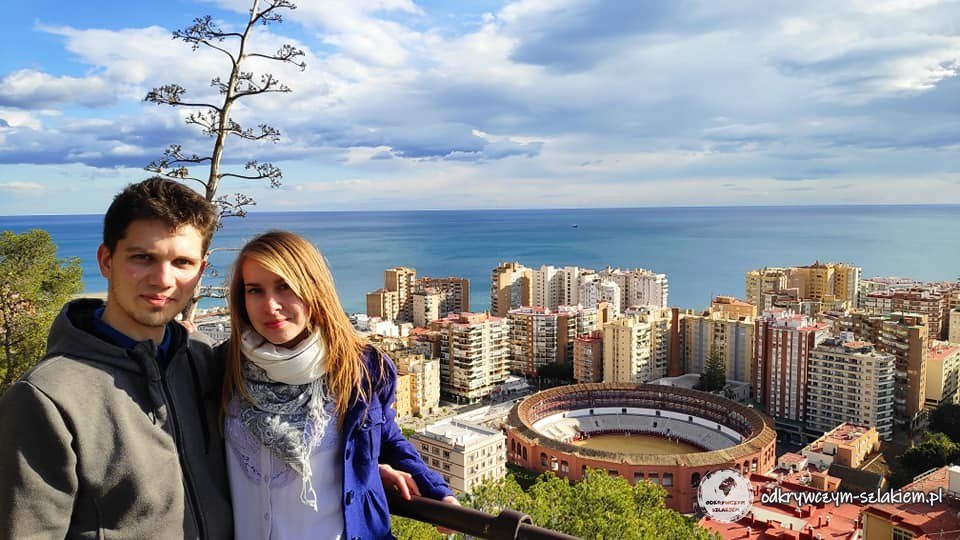
Plaza de toros de La Malagueta
During the season you can watch bullfights here. The bullring opened in 1876. The building has the shape of a 16-⁠sided polygon. Today it holds 9032 spectators.
Málaga Cathedral (of the Incarnation)

One of many examples of Renaissance religious architecture in Málaga. The cathedral was built between 1528 and 1782 in the Renaissance style. Inside you can admire mainly Gothic decoration.

The cathedral stands on the site of a former mosque, yet it has no Arab elements. After capturing the city, the Catholic Monarchs decided to destroy the mosque and build a cathedral in its place. The only surviving element from Arab times is the gardens.
Visits are possible daily from 10:00 to 18:00, on Sundays from 14:00 to 18:00 – last entry 45 minutes before closing (as of July 2021). In high season it’s a good idea to buy tickets in advance. That way you avoid queuing.

Málaga – second day of sightseeing (video)

The Alcazaba fortress
It is one of the largest Muslim military buildings preserved in Spain. The fortress was built between 756 and 780. Its name comes from the word for citadel (in Arabic, al-qasbah). The fortress stood above Málaga, protecting the city and the port from pirate attacks. It houses exhibits of Phoenician, Roman and Arab pottery. Inside the castle there are also gardens laid out by both Moorish and Catholic rulers.

In summer (April – October) the Alcazaba is open daily from 9:00 to 20:00, in winter (November – March) from 9:00 to 18:00. A standard ticket costs €3.50, and combined with entry to Gibralfaro Castle – €5.50. On Sundays from 14:00 to 18:00 entry is free (as of July 2021). You’ll find the current prices here.

Castillo de Gibralfaro
A castle of which only the defensive towers have survived. It was built by Yusuf I (a Muslim ruler) in the first half of the 14th century. Thanks to a lighthouse nearby, it was named “the fortress with the lighthouse”. After the period of Arab rule, the castle and the Alcazaba became a residence of the Catholic Monarchs. Later, until 1925, it served mainly military purposes. On top of the wall there is a viewpoint with a fantastic panorama of the city against the port and the sea.

There are also viewpoints on the way up to Gibralfaro Castle.

This castle can also be visited free of charge every Sunday – from 14:00 to 18:00 (as of July 2021). Opening hours and prices on other days are the same as for the Alcazaba.

The Roman Theatre of Málaga
The Roman Theatre is evidence of the Roman presence in this part of the Iberian Peninsula. It was built in the 1st century BC, during the reign of Octavian Augustus. It remained in use until the 3rd century. Later, after the Moors conquered Málaga, the theatre became mainly a source of stone. Unfortunately, because parts of it were used to build the Alcazaba, it was badly damaged.

It’s worth going up to the viewpoint (Mirador de la Alcazaba) just behind the theatre.

Opening hours of the Roman Theatre – Tuesday to Saturday: 10:00–18:00, Sundays: 10:00–16:00, on Mondays the theatre ruins are closed (as of July 2021). Entry is free.

La Concepción Historical-Botanical Garden
It’s a wonderful English-style park founded more than a hundred years ago. You can admire thousands of unique plants here, brought from even the most remote corners of the world. On top of that, the great asset of La Concepción is its architecture – the pavilions and gazebos often imitate ancient buildings and blend in nicely with the greenery around them.

Opening hours – 9:30 – 17:30 (October–March) and 9:30 – 20:30 (April – September). On Sundays (October–March from 14:00 to 17:30 and April–September from 16:30 to 20:30) entry is free (as of July 2021). A standard ticket costs €5.20. You’ll find the detailed price list here.

The port of Málaga
The oldest continuously operating port in Spain and one of the oldest in the Mediterranean. To see the port of Málaga in all its glory, it’s worth going up to one of the roof terraces, e.g. the terrace of the Marriott hotel.
Playa la Malagueta (beach)
On this long beach you’ll find, among other things, the distinctive stone lettering “Malagueta” and a playground where you can ride a tyre hanging from a rope.

Practical information

  • On Sundays most attractions are free.
  • For Málaga, set aside at least two days.
  • Free parking is marked with white lines. Close to the centre, I recommend parking on the left side of the Guadalmedina river (e.g. on Calle Mármoles or Av. Fátima and nearby). During our stay we were confused by orange lines, which could be read as a parking ban. It turned out, though, that they were left over from roadworks.
  • Accommodation: we spent three nights at the Malaga Centro hostel, less than a kilometre from the very centre. For two people for one night it came to about €28 (January 2020). You can see what it was like in the videos above.

Did you enjoy this article?

Stay with me on the road – follow me wherever you like best.